Rich Reviews- Frozen II

frozen-2-2019-review-7-1024x576.jpg

There is, perhaps, no film in the Disney animated canon simultaneously as popular and as divisive as the 2013 return to musical form, “Frozen”. On one hand, critics and audiences adored the film upon its initial release for its revival (and mild subversion) of the animated musical Disney movie, its infectious, well-performed songs, and its impressively animated cast of now-iconic characters. Over the years, however, there’s been noticeable backlash against the film (or more accurately, the film’s over-saturated presence in merchandise and Disney branding), and one can find no shortage of amateur video essays or professional critiques lambasting “Frozen” as an overrated entry in the Disney filmography. Given this, it goes without saying that a sequel to “Frozen” and the necessity thereof would be a polarizing, borderline contentious topic among critics and audiences alike, since one could easily chalk up the reason for the sequel’s existence to simple brand maintenance. What makes the sequel so hard to meaningfully evaluate, however, is the sheer amount of ground to cover on both ends of the critical spectrum, and this is only in reference to its predecessor.

I’m of the mind that the original “Frozen”, while flawed in its characterization and distribution of screen time, is still a fun, enjoyable musical that evokes the “Disney Renaissance” era of animated musicals in a visually appealing way, and that appeal was bolstered by a decent soundtrack, some wonderfully animated winter visuals, and a memorable cast of characters. Still, I did take enough umbrage with those aforementioned pacing and characterization flaws that I hoped the sequel would tie up the loose ends of the original, which led me to seeing the movie and hitting the aforementioned critical rut that I currently find myself in. On one hand, the movie is just as superfluous and average as some of the naysayers predicted it would be, while on the other hand, I can’t entirely feel like my time was wasted just by virtue of the fact that “Frozen II” is still  entertaining and interesting enough of a movie to discuss.
Set three years after the first film, “Frozen II” continues the story of Elsa of Arendelle (Idina Menzel), the ruler of the icy kingdom, who, along with her sister Anna (Kristen Bell), ice harvester Kristoff (Jonathan Groff), and the sentient snowman Olaf (Josh Gad), is celebrating the relative peace of autumn when she begins hearing a mysterious voice calling out to her in song from beyond the seas. Convinced that this voice has something to do with a story their father once told them about the enchanted forest beyond Arendelle’s seas, Elsa attempts following it, only to awaken elemental spirits that consequentially force the kingdom’s citizens to evacuate. Upon learning that this forest and the kingdom of Arendelle share a resurfacing history with one another, Elsa sets out with her sister and their friends to set things right, all while questions surrounding Anna and Kristoff’s relationship, the kingdom’s dealings with the druidic forest-folk, and the origins of Elsa’s icy powers are raised along the way.

For the first time in awhile, I’m inclined to be more traditionally balanced in addressing “Frozen II’s” pros and cons, since my thoughts on the film are as mixed as they are. Still, in the interest of that balance, I’ll start off by saying there are genuine achievements present in this sequel that I felt expanded on things done well in the first film. As expected, the animation is top-notch, and the “Frozen” series’ utilization of snow and lighting effects continues to astound me. Snow and ice-based visual effects are as pretty and encapsulating here as they were back in 2013, and they’ve expanded on the spectacle of the seasonal atmosphere in little ways, such as the tossing of leaves through the wind and the permafrost on Olaf’s body. What really grabbed my attention about the film’s visuals, however, were the atmospheric effects present in the enchanted forest. Once the journey properly begins, the cast enters into a visually arresting realm of untamed nature, where fire, earth and water are animated with as much luxurious depth as the ice and snow in this and the previous movie. While not revolutionary, “Frozen II” at least succeeds in having its animation be evolutionary.

Also much like the first film is the soundtrack, which is continues to be grandiose, sweeping, and infectiously catchy. In fact, I’ll go so far as to say I liked the music better here than in the first “Frozen”, at least in some ways. While “Let it Go”, “For the First Time in Forever”, and “Love is an Open Door” were well-written and well-orchestrated songs, I personally found the rest of the first film’s soundtrack to be alright at best and gratingly dull at worst, with songs like “In Summer” and especially “Fixer Upper” dragging the whole score down for me. While not quite as memorable as the last movie’s signature songs, though, the “Frozen II” soundtrack makes up for that lack of staying power in cohesive consistency, with songs that more directly flow through the narrative and maintain the tonal consistency that was much more muddled in the last movie’s song list. “Into the Unknown” is a sweeping call to adventure and a worthy spiritual successor to “Let it Go”, and even the more comedic musical numbers benefit from their orchestration in ways that the comic relief songs in the first “Frozen” did not. Keeping in the spirit of “evolution over revolution”, Frozen II’s soundtrack is one I’d call satisfactory.

It’s in the narrative, however, that my overall thoughts become a little harder to define, for while this sequel does deserve some praise for taking some risks and attempting some meaningful exploration of its main characters, it loses some of that praise (at least, on my end), for some of the pacing and writing problems those present. For one thing, I’m of the mind that this should have primarily been Elsa’s movie, since the subplots only serve to divert attention away from her investigation of the voice and the enchanted forest. While Anna’s story tying into this main plot is fine, the other characters border on superfluous, with the worst of the subplots being Kristoff’s struggle to propose to Anna. His is a tried and true romantic struggle, by which I mean it’s the kind of “propose to the girlfriend” plot point that thrives on contrived miscommunication and will not be resolved until late into the story, which plays into the bigger problem with the film’s narrative- its predictability. While the discoveries present in the film’s second act do make for some worthwhile world building for Arendelle and the world beyond it, “Frozen II’s” story completely face-plants once the third act draws near, as if the creative team struggled under the weight of the aforementioned raised questions. It becomes very telegraphed by the end, and I ended up leaving the theater with no idea what my final verdict was.

All in all, I’d describe “Frozen II” as “not quite ambitious enough.” Those who enjoyed the first movie will still find plenty to like about it, but the telegraphed, sophomoric narrative turns and the over-familiarity of this movie’s tone may end up detracting from that entertainment quite a bit. Take this one with a considerable grain of salt.

Daulton’s Diatribes- Cats (2019)

_the-entire-plot-of-cats-recreated-with-quotes-from-baffled-reviews.jpg

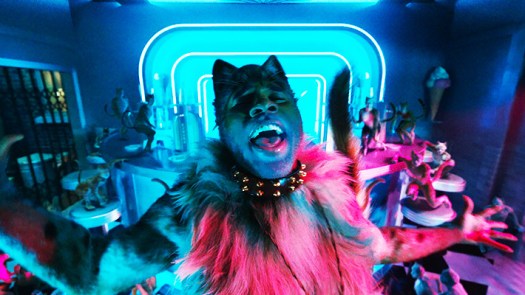
It’s a cold night as I sit glued to the chair of a small theater I regularly go to with my girlfriend Erin, who’s sitting next to me. I’m sitting there as if I was a prisoner to my mind and the images before me while many thoughts, questions, and images float through my head as the credits roll. I think to myself how I feel like Alex Delarge being forced to watch horrific images on a theater screen in “A Clockwork Orange”, I think about all the excellent films I could have seen and reflect on the Lovecraftian horror of the cats bodies in the film and it’s bizarre proportions. We all cry out at various points over the bizarrely sexual nature of this PG film, which our small audience of 7 wasn’t prepared for, and all normal theatrical decorum vanishes. We have bonded in the same way as trench soldiers in WW1 did… simply over the horror we’ve seen. The last thing I think of, though, is my hatred of Andrew Lloyd Webber and Tom Hooper, and I ponder on them as I step out of the theater back into the cold night. I know leaving that I’ll never forget this night, the bitter air bites into me as I laugh in the cold night air maniacally because I know something… all I have to do to get people to recall this night is walk up to them on the street and say one word: “Cats”. They’ll know what I mean, and we’ll have an ETERNAL soul bond, they’ll know they were in the theater with me from that alone. This film has changed me in ways I’ve only read of in the greatest horror novels.

So yeah, let’s talk about the “plot”, I guess.

Tom Hooper’s latest stage to screen adaptation after 2012’s “Les Miserables” is Andrew Lloyd Webber’s “Cats”: a stage show based off a collection of T.S Elliot poems about cats (shockingly enough)! The show and film take place in London on the night of the Jellicle Ball, an event attended by a group of cats known as the Jellicle Cats, who visit the ball to win the favor of their leader Old Deuteronomy, who will use their magical power to reincarnate a cat by sending them to the “Heavy Side Layer”. We meet various characters throughout the play who are primarily introduced by the narrator Munkunstrap as the Jellicle Cats avoid the evil Macavity. I know that sounds like a brief and vague plot, but that’s because it is!

The film features a large cast of well known Hollywood celebrities like Judi Dench, Ian McKellen, Idris Elba, and Rebel Wilson. We also have to deal with more obnoxious stunt casting on the part of Tom Hooper by using celebrity musicians in the form of Jennifer Hudson, Taylor Swift, and the extremely current and relevant…Jason Derulo?? It also features some stage veterans like ballet dancer Francesca Howard, who plays the closest thing the film version has to a protagonist in the form of Victoria.

I went into this film for a “so bad it’s good” experience after seeing the initial trailers, reviews, and just the fact some studio executives felt it would be a fantastic idea to adapt an old Broadway punchline. Andrew Lloyd Webber is a rather infamous creator in the theater circle, with many critics and theater geeks despising his spectacle driven shows for their shallow characters, repetitive nature, and a reliance on existing properties and actual people to put people in seats. There’s also the matter of the LARGE number of plagiarism accusations Webber had gotten over the years, with the most famous being how similar the opening suite of “Phantom of the Opera” sounds to the Pink Floyd song “Echoes”. Tom Hooper has also been despised for his shoddy directing and casting of theater darling “Les Miserables”, and was a poor choice to direct the adaptation of Webber’s surreal nightmare of a show. I went in looking for a good time, and while I certainly found something, I don’t know exactly how to qualify this experience other than to compare it to other forms of media involving the things mankind wasn’t meant to see. To nail down the issue of this movie we have to primarily discuss the effects and Tom Hooper’s terrible directorial choices.

The stage show “Cats” has generally received praise for three core things: its makeup work, choreography, and its stand out track “Memories”, the utterly heartbreaking ballad of the dying old cat Grizabella. The first way Hooper ruins the charm of the stage production is skipping makeup entirely in lieu of CGI for budgetary reasons, which causes the cats to fall rather deeply into the uncanny valley. The human faces of the actors are imposed on these weird anthropomorphic feline forms that have way too many human features, like the hands, nose, and feet, which makes them seem just plain wrong. This complaint was so prominent “Cats” was actually given an updated version in most theaters after about a week of being out to fix some rather glaring errors, as well as tighten up the CG effects, the most notorious issue being how the VFX failed to get Judy Dench’s hands, leaving her clearly human hand with her wedding band on it plainly visible. Choreography is excellent due to the hiring of many theater and ballet dancers as extras, but combining that with the clearly CG dancers and the bizarre nature of the cat proportions makes every dance number look more at home in your nightmares than in a PG family film.

Speaking of PG, the movie is uncomfortably sexual, with Rum Tum Tugger’s number (played by singer Jason Derulo) and Bombalurina’s number being the most clear examples along with actors just constantly thrusting, yowling, and giving each other bedroom eyes. Finally, the songs are ruined by Hooper’s idiotic decision to not include a click track to keep actors on beat and his insistence on his “dramatic” style of singing he directs, in which actors essentially speak-sing, which makes so many numbers feel like a William Shatner spoken word album that can’t even stay on beat. It utterly robs Jennifer Hudson and Taylor Swift of otherwise fantastic performances.

To conclude this, there are MANY words I could use to describe “Cats”, such as horny, soul crushing, and uncomfortable, but I’ll simply conclude with my thoughts on how theaters need to handle this film. They can obviously continue to show it, but they need to add a warning sign like films with epilepsy risks do. The sign will simply have that famous old saying-

“Abandon all hope ye who enter here”.

Rich Reviews- Uncut Gems

ob_07fa0e_egljnfncrphfyg2rxxmme0oku5.jpg

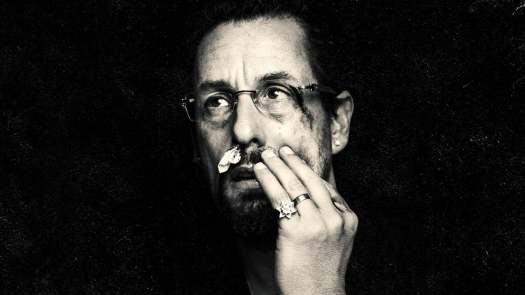
After ending last year with a review of “Star Wars: The Rise of Skywalker”, I had come to the conclusion that I could only inject that much vitriol into my reviews before being burnt out. After all, I don’t take any sort of pride in playing into the well-worn cliche of the angry, snooty critic, and I am much more genuinely happy to sing praises for remarkable successes in the world of film. As such, I knew I had to avoid recent January releases like the plague, hence the absence of a proper review for the widely-mocked remake of “The Grudge”. Much as I hate to be predictable or trend-chasing, there are times when a critic needs a break from the bad end of the spectrum, especially when they have the option of seeing fantastic movies like “Uncut Gems” in theaters. Released in the middle of December, this film, written and directed by the Sadfie brothers, served as a remarkable introduction to their work for me, and is carried by both the cinematic talents of its directorial duo and the engrossing lead performance of an actor with understated dramatic power- Adam Sandler.

Sandler plays Howard Ratner, a Jewish-American jeweler addled by gambling debts, an encyclopedia’s worth of ego problems and addictions, and a chaotic personal life divided between his soon-to-be ex-wife (Idina Menzel) and his workplace mistress (Julia Fox). The already-harrowing circumstances of Ratner’s line of work come to a head when he obtains a black opal-encrusted rock from an Ethiopian mine and plans to auction it off to rectify his debt to a New York loan shark (Eric Bogosian). What starts out a a simple way to cover his dues with the priceless uncut gem soon becomes a tangled web of sports bets, illicit trading, and interpersonal tensions as Ratner hustles clients, burns bridges and continues to dig himself a deeper hole in pursuit of maximized profits. Struggling inside this web along with the conniving crook is his assistant, Demany (Lakeith Stanfield), who (along with Ratner’s mistress Julia) sees all too well that his employer is struggling with a downward spiral of his own creation.

As Adam Sandler’s presence in “Uncut Gems” is the most readily apparent and widely marketed aspect of the film’s achievements, I think it only prudent to begin this critique by stating outright that he has delivered quite possibly the best performance of his career as Howard Ratner. Though the primarily comedic actor has been (sometimes rightfully) mocked for his low-quality films under the “Happy Madison” production label, I’ve been much less inclined to write him off as a laughing stock due to his genuine talent in the way of more serious, dramatic roles. Films like “Punch-Drunk Love” and “Reign Over Me” have proven his legitimacy as an actor before, but in “Uncut Gems”, he treads into thus-far uncharted territory in his career- the role of a self-defeating, manipulative con artist. Ratner is, in spite of the sympathy elicited from his plight, a thoroughly contemptible man that only escalates his problems and those of the other characters, and Sandler gives the character a much-needed sense of slimy charisma twinged with deep contempt for the people holding his debts over his head. Sandler, in this sense, is the navigator of this film, guiding the audience as they follow his journey into chaotic business transactions and interpersonal manipulations. It should be said, however, that Sandler certainly does not carry this story alone, as the performances across the board are powerfully intense and believable. Highlights of the supporting cast include Lakeith Stanfield as Demany, who makes for a great level-headed straight man to the scheming Ratner escalates, basketball player Kevin Garnet, who plays himself and convincingly acts the part of a victim of conspiracy, and Julia Fox, who turns in a surprisingly sympathetic performance as the object of Ratner’s extramarital affair.

Still, the strengths of this movie certainly don’t begin and end with the performances of its cast. For instance, the direction, cinematography and visual storytelling of “Uncut Gems” are all gloriously sharp and on-point. Hearing that Josh and Benny Safdie are well-versed in high-tension crime movies makes a lot of sense after seeing this film, as the cuts from scene to scene are keenly edited and contribute to an intense, all-encompassing sense of anxiety as the stakes of the film’s narrative rise and rise. One visual element of note is how the film makes use of the titular uncut opal in certain transitions, the details of which I won’t dare spoil since it has to be seen to be truly appreciated. I’m especially astounded by how well the editing and cinematography work on both the momentary and structural levels, since the transitions and cuts are fantastic at creating scene-to-scene tension and at maintaining the thrill of the more harrowing scenes in even the most low-key moments of the story. It’s this sort of consistently gripping atmosphere that makes the plight of the characters, Ratner in particular, all the more compelling in spite of their relative lack of sympathy, and combined with the aforementioned performance of Adam Sandler, aids the audience in being engrossed in his struggles. The cherry on top of this metaphorical tonal sundae is the film’s soundtrack and score by Daniel Lopatin, which combines electronic trills and ambience with African choirs in order to punctuate moments of escalating tension with cinematic flair. This score is wholly unique and deserving of attention in an age where spectacle is favored over melodic nuance. All of this is in service to an expertly written screenplay that sets the stage for sharp character interactions and a narrative rife with scheming, intrigue and thrills. The cinematic and narrative elements thus coalesce into a brilliantly cohesive piece of cinema that grasps the attention of its audience and rarely loses its grip, if at all.

“Uncut Gems”, in other words, is the type of critical darling film that has every reason for its success, and I’ll go so far as to say that its release is nothing short of inspirational. That a film like this, made by two relatively new filmmakers and starring an actor with comedic origins, is getting enough praise to be considered for the Oscars, is a joyful prospect, at least to me, and the film itself is an almost universal success in the world of crime thrillers. If nothing else, it would certainly make the Academy Awards nominations list seem a lot less toothless. See this in theaters while the chance is still there.

Rich Reviews- Star Wars: The Rise of Skywalker

The-Rise-of-Skywalker-exclusive-Vanity-Fair-preview-star-wars-42807275-1280-818.jpg

One of the most difficult things about film criticism, especially in regards to an entry in a long-running franchise such as “Star Wars”, is separating one’s methodical analyses of the “objective” quality of its production and narrative from one’s own personal attachments to that particular brand or setting. One can only accomplish so much in the way of legitimate insight on a film’s achievements and failures if they are hyper-focused on their attachment to a greater canon, after all. This is part of the reason why I wait as long as I do to review a film after I see it in theaters: initial impressions and theater reactions serve as flimsy foundations at best for an opinion worth writing about. Another obstacle in the field of criticism is separating one’s own opinion of a film from the discourse surrounding it, as it can be easy for the base-breaking debates about a film’s merits to inform an individual’s opinion about a movie they haven’t even seen before. As such, I’d like to think I do my best to view a movie as a critic and an analyst, and not as a purveyor or fan of any established franchise or filmography the film occupies.

As one could probably guess, both difficulties were very much present in reviewing “Star Wars: The Rise of Skywalker”, especially when one considers the vastly different receptions of the previous film, “The Last Jedi”, among professional critics and audiences, specifically longtime fans of the greater “Star Wars” canon. Speaking as a somewhat lapsed fan of the franchise, I enjoyed the previous entry in the Disney-helmed sequel trilogy of “Star Wars” films, for in spite of some major flaws, “The Last Jedi” was an ambitious entry in a series steeped in spectacle and escapist science fiction that sought to subvert audiences’ expectations of characters and the narrative they occupy. As one could probably imagine, however, this direction made “The Last Jedi” a veritable magnet for controversy among fans expecting a more straightforward and traditional “Star Wars” narrative, and as time ticked down to the release of the “Skywalker Saga’s” conclusion, Disney, J.J. Abrams and those involved in the screenwriting process were faced with a difficult choice:

A. Continue in the direction set by the previous film, keeping things fresh and unpredictable in spite of the obvious risks to audience retention,
Or…
B. Cater to the previously-subverted expectations of the fans and return to the technically impressive, yet safe and shallow spectacle set by “The Force Awakens”, guaranteeing the type of film the fans will enjoy (and spend money on) in the short term.

Seeing as how the film clearly sticks to choice B, it’s safe to say that sticking to spectacle has worked in some way, because I am in utter awe at the unmitigated, inept disaster that has resulted from the narrative decisions going into “Rise of Skywalker”. The film meant to cap off this sequel trilogy seems to be exactly what the fan have demanded their continuation be, and is a perfect demonstration as to why this kind of pandering approach is so poisonous to a film’s overall quality and longevity. With maximum consideration for spoilers, I’ll attempt to explain why fan service does not make a movie.

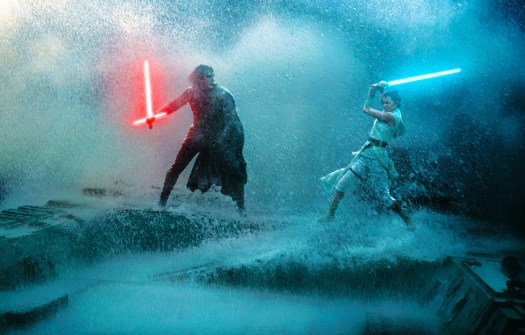
Shortly after the death of Supreme Leader Snoke at the hands of Kylo Ren (Adam Driver), The First Order once again mobilizes for galactic domination. Worse yet, the war between the Order and the Resistance seems to be leaning in the favor of the former, thanks to the reemergence of an ancient enemy of the free galaxy and the Jedi. The Resistance’s last hope is to find the location of the First Order’s home base and their secret weapons, both of which have remained uncharted for generations. Amidst this struggle, Rey (Daisy Ridley) is facing another conflict on a personal scale, torn between her vow to continue the Jedi legacy and the inexplicable pull that Kylo and the dark side seem to be exerting over her. Whatever choice she makes and whichever side remains victorious, one thing is made achingly clear: the end of the struggle is nigh, and the Force shall persist, one way or another…

And it will do so in the most hackneyed, predictable and ham-fisted way immaginable.

Inclined as I am to do so, I will NOT be spoiling anything about the plot of this film. I believe it completely unprofessional to ruin the contents of a story for anyone, regardless of its quality, because I feel it’s best for my criticisms to speak for itself, and because some of the bad material needs to be seen to be believed. Without context, however, I must recount how baffling it was for me when the first major retcon and abortion of plot logic occured in the first thirty seconds, during the traditional intro text crawl. If that was not indication enough, “The Rise of Skywalker’s” pacing problems are as inconceivably apparent as they are constant. The aforementioned returning threat is not established at all prior to this film, and the opening is dedicated to the rushed, hand-waving explanation of this return until cutting away to an action scene that wraps up in an equally rushed and baffling way. From there on out, “Rise of Skywalker” dedicates itself to being less a cohesive film and more an unnecessary apology for “The Last Jedi”, as characters that were once crucial to the development of the protagonists are barely even given the dignity of a line because of poor fan reception, and potential threats are immediatelly doused before they have a chance to allow the audience to doubt the outcome of each plot point and character arc. One awful (spolier-light) recipient of this is Finn, whose entire development under the struggle of being alone in his defection from the Order is quickly wrapped up barely halfway through the film, and the other characters fair even worse than that. Rather than dedicate itself to anything unpredictable or thought-provoking, the film wastes its admittedly amazing effects and cinematography and the talented performances of its misdirected cast on shallow fan service that ceases to make sense if thought about for even a second. In fact, I’d dare say this blind dedication to making a “movie for fans to enjoy” is a worse approach than even the malligned prequel trilogy helmed by George Lucas himself, since there were not nearly as many structural and artistic problems with the redactions forced into JJ Abrams’ narrative this time around. “The Rise of Skywalker”, in essence, is just a typical “Star Wars” movie, and that is what its deadly flaw is.

I may be skimping a bit on the technical points of its quality a bit, since those are admittedly on point when taken on its own. But the lengths that this film goes to in its horribly written, horribly implemented and thematically damning conclusion to appeal to the supposedly let down fans who expected more of the same is as soulless as it is infuriating to witness. I’m not one to say anything ruined the idea of “Star Wars” or the art of filmmaking to me, but knowing that the kind of complaints directed at aspirational films like “The Last Jedi” had an actual effect on the filmmaking process speaks volumes to me about the proliferation of the soulless design of “film as product” that’s only getting worse among big production companies. It’s sad to me that this is what I end the year with, but I’m hoping I’ll have to be exposed to less of this the next time around.

Avoid “The Rise of Skywalker” at all costs, and if you see it, don’t be surprised if you’re enraged for hours on end.

If you enjoy my reviews, please consider supporting me and becoming a patron for acknowledgements, requested reviews, and more via the link below-

https://www.patreon.com/user?u=23167206


Rich Reviews- The Addams Family (2019)

MGM-Addams-Family-picture.jpg

Happy Halloween, readers!

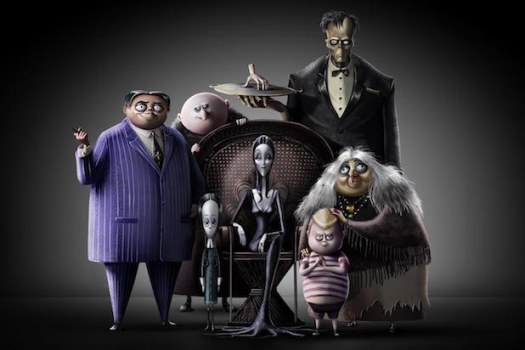
A few days ago, for my first Halloween-based “Ruminations” post, I put out an argument for why I felt it important to introduce children to macabre, vaguely horror-based themes to them via mass media, specifically movies. To that end, I was as excited as most were when MGM’s animated feature-length film iteration of the iconic “Addam’s Family” was announced. After all, the famously macabre stars of TV and comics have a long and proud history of dark horror comedy and a quirky, off-kilter sense of humor revolving around masochism and a love for all things considered bleak and horrifying, and a an animated theatrical film that uses a style pulled straight from the original comic strips seems like a perfect candidate to qualify as the next “Coraline”- a surreal, sometimes creepy, yet charmingly amusing comedy horror to revitalize the franchise. After seeing the movie, I’m happy to announce that the film’s release qualifies as a good case in point of what I had previously discussed. Unfortunately, I’m unhappy to announce that such a designation was earned for less-than-stellar reasons. The foundation for something truly surreal and memorable was laid by both the animation and the relative faithfulness to the source material and its characters, and I was more than eager to see this movie and use it as a case study for why kids need a little creepiness with their wondrous adventures in film. Instead, however, the end product was a disappointment in many ways, torn between the tone of an established franchise and a slavish devotion to the narrative of completely different and safely conventional stories typical of contemporary animated films.

Immediately following their marriage on the outskirts of a quaint village, Gomez (Oscar Isaac) and Morticia Addams (Charlize Theron), along with their extended families, are chased out of the community by torch-wielding townsfolk for their off-putting creepiness and fascination with the macabre. Following this, they are able to find a much more safe and accommodating (albeit very dilapidated) home in the form of an abandoned asylum, making an effort to turn it into the spookiest and creepiest abode the Addams could wish for. Over the years, Gomez and Morticia makes themselves thoroughly at home with their children, the eerily morose daughter Wednesday (Chloë Grace Moretz) and the rambunctious son Pugsley (Finn Wolfhard), but the security they’ve found in their gothic mansion comes to a screeching halt when an emerging suburban community threatens to send them running again. Worse yet, the Addams children are facing their own turmoils, with Pugsley cracking under the pressure of an upcoming family tradition centered on a dance of swords and Wednesday longing to see other places and people outside her home. Will the Addams family pull through together and circumvent these bumps in their roads to happiness, or be run out of town and forced to live as a dysfunctional family of so-called “monsters”?

Before closing in on the disappointing factors of the “Addams Family’s” latest big-screen incarnation, I feel it’s imperative to bring up that there’s a lot about this film that I do legitimately like. For instance, the movie’s animation and art style are both fantastic, and both do wonders at remaining faithful to the original designs of the iconic characters while expertly imbuing life into the designs, especially during the action or slapstick scenes. The characters are wonderfully expressive, the Addams house is full of lushly detailed set-pieces and nods to the franchise’s roots, and the comedic timing is especially on point due to the flexible and fast animation at work during those aforementioned scenes. Even removing the animation, the characters themselves are, for the most part, incredibly faithful and wonderfully performed by the star-studded cast. It’s easy at first to roll your eyes at the over-reliance on celebrities in the cast, but it’s amazing how well they slip into their respective members of the family. Oscar Isaac and Charlize Theron, for instance, are remarkably spot-on as Gomez and Morticia. The otherwise morbid couple are still just as madly in love with each other as in previous incarnations, and I was especially impressed by how expressive and unrecognizable Theron was as Morticia. Finn Wolfhard is serviceable in his rambunctiousness as Pugsley, and Nick Kroll is easily the funniest cast member as Uncle Fester, whose antics got plenty of chuckles out of me whenever he was on screen. My personal favorite out of this cast, however, was Chloë Grace Moretz as Wednesday, who lends plenty of deadpan humor and some surprising nuance to the character who arguably laid down a foundation for young “goth girl” characters to come. It’s clear that everyone involved in the production and acting ends of “The Addams Family” had some genuine love for the source material, and with that love demonstrated in the acting, animation, and humor, this film is an amusing, chuckle-worthy and loving tribute to the Addams Family…

For the first forty-five minutes.

Once those forty-five minutes are over, the film seems to remind itself and the audience that a feature-length “Addams Family” movie needs to have a plot and a message (regardless of the actual need for one), and proceeds to squander every bit of the potential it had to be the kind of film that could spook families without either pandering too or traumatizing their younger members. That previously discussed plot of the traditional suburban community striving for conformity and aiming to drive out the Addams “weirdos” eventually starts to have a cancerous effect on the film’s overall memorability and appeal, and this is only exacerbated by the circumstances of its incorporation. The problem with every modern iteration of “The Addams Family” has always been that the characters are not exactly ideal to place in the middle of a traditional three-act structure, and are more suited to a comparatively episodic film narrative about dark humor and horror-based gags. That’s not to say that a more sentimental or personal “Addams Family” story couldn’t work, but such a narrative needs time and pathos to truly work in a story about these characters. What we have here is a perfect demonstration of how not to bring drama into a story, as the second half of the movie spends way too much time on Wednesday’s friendship with an uninteresting school girl and the scheming of the villainous TV host, who has all the charm and personality of a wet cat. This villain is just annoying, and her only function is to be a catalyst for a half-hearted message about societal pressures and the acceptance of differences weirdness, and while this message isn’t necessarily a bad thing, its execution falls flat on its face due to a simple, painful truth- this movie isn’t nearly creepy, kooky, or spooky enough to effectively convey that message. In the middle of that second half, I got the impression that the filmmakers were nearly finished production of a grimly funny “Addams Family” free from the burden of a plot until executive mandate demanded that there be a plot or message by virtue of it being an animated family movie.
That reasoning, however, is not so much an extra layer added to the “Addams Family” lore as it is a demonstration of weak faith in its source material, because “The Addams Family” does not need this superfluous thematic addition. The characters aren’t just a generic creepy family, they’re icons, and the dark antics they bring to the table should have been considered material enough for a worthwhile movie. With more of the franchise’s iconic and surreal edge applied, this could have been up on a shelf with “The Nightmare Before Christmas”, “Coraline”, “Monster House” and “ParaNorman” as a great creepy family film for a general audience to both laugh and flinch at. Instead, the 2019 “Addams Family” seems like it’s afraid to fully commit to that direction or to its own source material.

All in all, “The Addams Family” isn’t outright bad, just fairly unimpressive. I’m just sad that so much potential was squandered when there was such clear enthusiasm evident in the movie’s characterization and animation. “Mediocre” just wasn’t a word I wanted to use for a movie about these charmingly creepy horror-comedy legends.


If you enjoy my reviews, please consider supporting me and becoming a patron for acknowledgements, requested reviews, and more via the link below-

https://www.patreon.com/user?u=23167206


Rich Ruminations- The Importance of Introducing Children to Horror Fiction

Scared-children2.jpg

Special thanks to Daulton Morrison, Chris Conte and Kiki Akpunonu for their contributions to this post.

Few topics are as contentious in the realm of film discussion are as contentious as the question of what films qualify as suitable for young viewers. This question is one that I am particularly frustrated by, mainly because it has greatly affected what films are successfully marketed towards children. While I’m in firm agreement that we shouldn’t desensitize (or worse, traumatize) child moviegoers through early exposure to violence and intense themes, I’m also one to believe that there exists an opposite extreme- the kind of film that treats younger audiences like absolute cretins. It’s this way of thinking that leads to the marginalization of the medium of animation as “kid’s stuff”, and perpetuates the output of relatively toothless children’s entertainment, with films being especially susceptible to this over saturation (see the typical “Illumination” film for proof positive of that). What frustrates me the most about the notion that children cannot be introduced to more mature media, however, is that there exists so many shows and movies explicitly targeted towards children and family audiences while aiming for dark or even horrific undertones beyond one-off Halloween episodes or other such outliers to the established tone of an established franchise. There are so many films and shows dedicated to what I’ll call “young/juvenile horror” media that I could make a more traditional “Top 10” list about them, but in the interest of keeping things varied, I’ll instead be briefly listing examples that I and some longtime friends of the blog brought in conversation, and using them as examples of how to strike a great balance between the horrific and the lighthearted. With this approach, I hope to give a tentative piece on how and why we should introduce the horror genre to our children.

Examples of Child-Appropriate Horror Films/Media

Looking back at some of my favorite films and shows from my youth revealed a lot of potential gateway drugs to the larger horror cannon for younger viewers, and those aforementioned collaborators only revealed even more candidates that I previously overlooked. For instance, the Cartoon Network animated series “Courage the Cowardly Dog” is a very important show on a personal level, as its surreal animation, dark humor, and surprisingly grim monster-of-the-week formula served as my first introduction to the sort of horror-comedy that made Sam Raimi and Peter Jackson famous in their early days. The show might have been responsible for many a nightmare (especially with the imagery it made use of), but it also had its share of comedic and even wondrous elements in some places, and some episodes (“Last of the Starmakers” and “The Hunchback of Nowhere”, to name two) could more accurately be classified as “dark fantasy” than outright horror. Friends and longtime brainstorm contributors of mine have also pointed to shows like “Invader Zim” as surreal and gruesome, yet still light and funny examples of shows for kids that weren’t afraid to be visually or thematically macabre. Horror animation wasn’t just a reality for televison, however. The motion-capture film “Monster House”, for instance, is one I consider an underrated example of the “spooky kids adventure” genre, populated by such films as “The Goonies” and “Monster Squad”, as it takes advantage of its often unsettling animation and focus on prepubescent characters to create a fun and creepy monster movie. The three protagonists’ banter and “Scooby-Doo” styled antics are undoubtedly amusing, but the accerbic and sardonic nature of the suburbs’ inhabitants and the origin story of the titular house makes for an endearing and fun movie for both kids wanting a light scare and adults feeling nostalgic for horror films of their youth. This kind of balance made these shows and films accessible while also having its own unique and mature edge, and that sort of balance is key to having a piece of media qualify as good “juvenile horror”.

Especially interesting to revisit, however, were the types of “baby’s first horror” films that I would have never considered until getting second opinions on the ideal introductions to the genre. For instance, horror fanatic and longtime friend of the blog Daulton Morrison pointed to “Ernest Scared Stupid”, the Halloween-themed installment of the Ernest P. Worrell films starring the late Jim Varney. Though primarily a comedy film (and a fairly silly one at that), there are elements that Daulton pointed out as being highlights that helped the film qualify as a good first horror movie for kids. The film’s antagonist, for instance, is a fairly creepy troll that, while not outright scary, benefits from a detailed and ugly design and the sub-textually horrifying power to drain the life force from children by turning them into wooden dolls. Re-watching the movie might not have endeared it to me completely, as I’m still of the opinion that the Ernest character can be fairly grating and stupid even by kid’s movie standards, but I will concede that there were some good “jump scare” moments involving the troll and even some good camera work here and there, such as the troll’s chase with his first victim in the 19th century, during which the POV shots pay clear homage to “Evil Dead’s” first-person tracking shots. Leaning further into slightly darker horror material in the midst of this discussion revealed a lot of good introductory media for kids in the world of T.V., what with anthology shows like “Are You Afraid of the Dark?” and “Goosebumps” ruling the roost on Nickelodeon and Fox Kids. Though the episodes of both shows naturally varied in terms of individual quality, the best of these episodes tackled very age-relevant themes through supernatural elements, and the stories were not afraid to have dark twist endings. “Goosebumps” in particular proved an interesting case study for the necessity of the genre in children’s media diets, as the books on which the show was based have a long and proud history of getting children invested in reading. One book/episode in particular, “The Girl Who Cried Monster”, is not only a legitimately creepy story about a young horror lover and prankster learning to be careful what she wishes for, but is bolstered by a menacing antagonist in the form of a librarian who threatens to eat her once she discovers his true monstrous nature. This monster teacher is not only imposing on the surface level, but also on a meta-textual level, as his condescending chastisement of the girl’s interest in pulp horror over more traditionally “classic” literature is a clear reflection of the snobbish teachers that once tried to remove the literary gateway drugs from school shelves during the height of the series’ popularity. Furthermore, the ending, while fairly dark, ends on a relatively happy note with the girl coming to an understanding with her family (revealed to be peaceful monsters) and the librarian dispatched, making it a creepy, yet accessible example of children’s horror. The fate of that librarian is meant to deliver a message to anyone, young or old, who has been shamed for liking horror stories- people who actively insult your interests are inflexible, disconnected elitist bullies that deserve to be called out as such, if not necessarily to be eaten by monsters.

On my end, however, films I consider the best examples of horror films for more general audiences are the early works of Tim Burton, namely “The Nightmare Before Christmas” and especially “Edward Scissorhands”. Both have dark visuals and narrative elements contrasted by an overall wondrous tone, but the latter is one of those stories that qualifies as “so simple it’s classic”. The titular protagonist is the center of a narrative reminiscent of the more misunderstood of the Universal monsters (especially Frankenstein’s monster), and tells a story of a gentle soul turned into a pariah and a monster by the worst of the neighborhood under his old, gothic home. Dark as that story gets, it’s an ultimately fulfilling story about love and its redemptive power, and about how fear, not “monstrosity”, is the root of humanity’s ills. I could go on and on about the movies perfect for introducing younger audiences to kids (Especially since “Ghostbusters”, “Beetlejuice”, and other such lighter horror-themed movies exist), but that still leaves room for the ultimate question:


“Why do Children need Horror Stories?”

Horror films, shows, and stories of this sub-category serve all sorts of purposes, among them being entertaining the family together (especially on Halloween), but the most worthwhile is a deeper function: to get children ready to think about darker fiction and darker elements of reality. Horror fiction is, in essence, our struggles and primal fears crystallized into fantasy, and the material I’ve thus far listed serves as a primer to those themes for children. Horror in kids’ films also offer much-needed variety in young audiences’ media diets, as the over-saturation of saccharine shows encourages a one-note mindset for developing audiences. Films like “Monster House”, “The Nightmare Before Christmas”, and the aforementioned “Edward Scissorhands”, among many other examples, can be funny, heartfelt, and chilling in equal measure, and that wide spectrum of tones, while risky in how uneven it can be, is important for young audiences’ ability to adapt to different moods and situations, both in and outside of fictional stories. In short, introducing horror to children is not just necessary because of the basic amusement of spooking children, but also because of the important phase of development: coming to terms with negativity and fear. After all, if life is capable of being any one thing at any time…

Why shouldn’t family entertainment?

Rich Retrospectives- Top 10 “Tales From the Crypt” Episodes


tales-from-the-crypt-reboot-update.jpg

WARNING: The subject of the following review contains references to gore, explicit violence, and horror themes. Reader discretion is advised.

Special thanks to Daulton Morrison for critical contributions to this post.

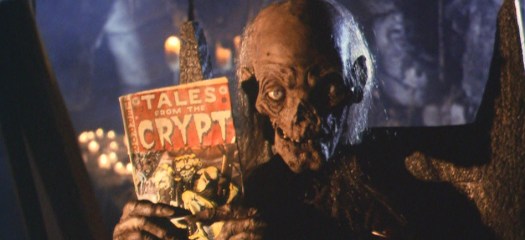
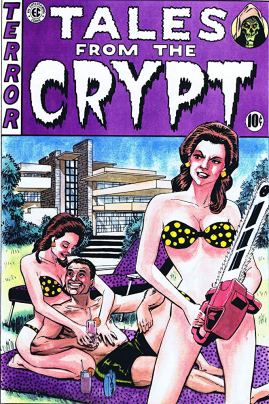
With October still in its early days, I figured I owed it to myself to get back into reviews by channeling some early Halloween spirit. Thankfully, I’ve got plenty in the way of material for that, because if there’s anything my now year-old review of “Creepshow” should prove, it’s that I adore horror anthologies, especially those that pay homage to the pulp horror comics of yore. Other than “Creepshow”, however, there’s only one extremely popular example of such tributes that continues to hold fondness and popularity among horror enthusiasts, and that example is the 1990’s TV show, “Tales From the Crypt”. Named after and based on stories from the horror comic magazine of the same name (along with stories from “Vault of Horror” and “Haunt of Fear”), the show garnered all sorts of attention on both sides of the critical spectrum for its campy sense of dark humor, wide variety of stories within episodes, and eclectic casts across the season. Its decrepit, pun-loving “Master of Scare-imonies”, the Crypt Keeper, has likewise become an icon among horror hosts, and even those unfamiliar with the show can at least point to him as a horror legend in his own right. In the first of a few Halloween-themed pieces between requested material, we’ll be taking a look at some of the most shocking, atmospheric, and darkly humorous of the show’s offerings across its seven seasons. With that in mind, I must once again bring up a content warning, as the episodes on this list can get REALLY disturbing. So I hope you all have strong stomachs, boils and ghouls, because here are Rich Reviews’ Top 10 “Tales From the Crypt”.

10. Split Personality
MV5BN2NjZjkyZjctMDg5YS00ZDU5LTg4YzItMDBjZjQwNGI2NzFmXkEyXkFqcGdeQXVyODI0NDgwNjA@._V1_SY1000_SX665_AL_

One of the most defining aspects of “Tales from the Crypt” is its sense of bitter, dark humor, and when it takes center stage in the more comedy-focused episodes, the results tend to be fairly… mixed, to say the least. The fan favorite “Cutting Cards”, for instance, fell just shy of taking this list’s 10th spot, for while that story of two bitter gambling rivals benefited from great performances, the end result fell fairly flat due to the one-joke narrative and the predictable twist. “Split Personality”, on the other hand, is an escalating shock comedy that benefits from all the things absent from that episode. It stars Joe Pesci as a two-bit conman who comes across a rich pair of twin sisters, opting to act as his own “twin” and court them both simultaneously to amass their immense fortunes.
What makes this episode work on the comedic side of things is the performance of Joe Pesci. It’s no secret that he’s perfectly at home playing a foul-mouthed, scheming con artist, but what’s especially remarkable is how well Pesci manages to pull of the lead’s facade of a humble gentleman, which makes the moments in which he breaks character all the more hilarious. On the more serious end of things, the narrative also manages to be suspenseful when it comes to the two sisters, for while it’s clear that they have their own tricks up their sleeves, it’s never too obvious what they have in store for the main character, making for something of a unique thriller amidst the shenanigans present in Pesci’s schemes. The episode looses points for leaning a bit too hard on the shock factor towards the end, but all in all, “Split Personality’s” performances and atmosphere make it a good episode to kick this list off.

9. The Reluctant Vampire
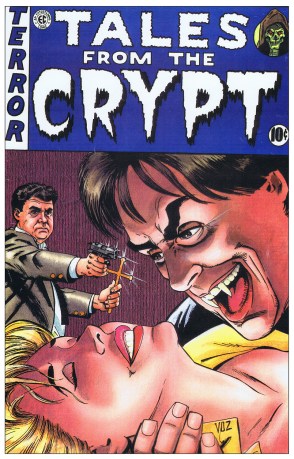
The-Reluctant-Vampire-tales-from-the-crypt-40706625-960-1500.jpg

Yet another comedic installment in the series, “The Reluctant Vampire” was one that I was originally going to list as an honorable mention for being as cheesy as it is, but was ultimately swayed by another fan of the show to put it here on this list due to Malcolm McDowell’s spot-on performance as the title character. Said character, Donald Longtooth, is a meek nosferatu who works as the night shift security guard at a blood bank in order to peacefully satiate his thirst. He’s forced to feed off of criminals and ne’er-do-wells to do so, however, when Mr. Crosswhite (George Wendt), threatens to lay off employees due to the subsequent blood shortage.
The tone of this episode is distinctly goofy and satirical, what with the hammy performances across the cast and the bumbling characters, most notably this story’s incompetent Van Helsing as portrayed by the normally terrifying Michael Berryman. Over the top as the final scenes become, however, this episode is legitimately funny and even heartwarming in some places, and both can be traced back to Malcolm McDowell’s acting. Never one to give a half-hearted effort no matter what the material may be, McDowell is great at playing up the meek and eccentric aspects of Longtooth’s character, and his chemistry with the female bank teller is all the more endearing and adorable because of it. One could argue that this fluffier episode even adds some variety to the series as a whole, and viewers looking for a more optimistic story to see on Halloween should definitely check this one out, especially seeing as how most episodes tend to be as dark as the following…

8. Easel Kill Ya
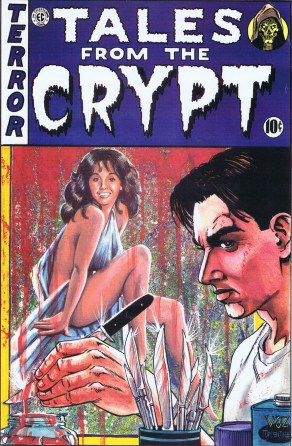
Easel-Kill-Ya-tales-from-the-crypt-40706412-1047-1600.jpg

Far on the other end of the spectrum is a twisted and bleak psychological thriller episode from the show’s third season. The title is about the only instance of camp in this story, following alcoholic painter Jack Craig (Tim Roth), whose macabre depictions of death in his art catch the eye of a mysterious benefactor who offers generous sums in exchange for more art in this style. This style, however, is a truly sick and costly one, as it entails Craig murdering random bystanders and using their blood as paint for the canvas, and even the support and love of his girlfriend Sharon seems unable to disperse the darkness within.
This episode’s twist becomes a fairly predictable one the further along the story goes, but what makes “Easel Kill Ya” work so well is its commitment to tone and intensity. The cinematography and sense for scene composition, for instance, is arguably the darkest and gloomiest of any episode of the series, and it’s all in service to a dark character piece about how addictions can take on many dangerous forms. The star of this nasty morality tale, the ever-underrated Tim Roth, does wonders bolstering the already disturbing story, delivering a tortured and temperamental performance befitting a violent recovering addict past his artistic prime. It’s episodes like this one that remind viewers that “Tales From the Crypt” was just as capable of legitimate and visceral horror when it wanted to deliver. Still, while there’s certainly more of that to come, the show was never one to forget how to have fun with horror. Case in point…

7. The Ventriloquist’s Dummy
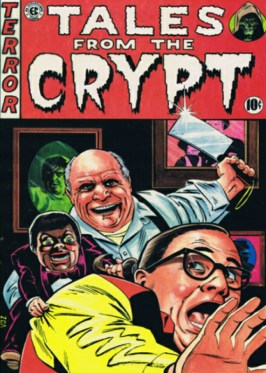
MV5BODQ0NjZhMGItYTM4Yy00OGFiLTliMmMtMjU1OTNkZGUyNDRmXkEyXkFqcGdeQXVyNjQyNTkzNg@@._V1_.jpg

One could probably guess which direction “The Ventriloquist’s Dummy” leans in, what with Bobcat Goldthwait and Don Rickles as the stars of this episode. Still, props should be given to this one for having a little bit of everything that makes “Tales From the Crypt” so memorable. Its story follows Goldthwait as Billy Goldman, an amateur aspiring ventriloquist seeking advice from his childhood hero, Mr. Ingles. This veteran entertainer, played chillingly by Don Rickles, had disappeared from the industry after a mysterious incident, and to Goldman’s terror, he’s soon to find out the ghastly secret behind his career.
Up until the second half, this episode is mainly driven by the performances and chemistry between the leads, and the interplay between Bobcat Goldthwait and Don Rickles is phenomenal. Goldthwait is surprisingly capable in the role of the naive upstart, and the normal bombastic and crass Don Rickles deserves special mention for how initially nuanced, bitter, and imposing his character is. What would have otherwise been a slow boil until the reveal is turned into a character study about the dynamic of new talents and their inspirations, and Goldman’s over-eagerness to follow Ingles’ path to the letter leads him into a deadly struggle reminiscent of an early Sam Raimi horror-comedy. I won’t spoil the circumstances of the hard turn into gory slapstick, but I will say that it’s made much less standard and predictable by the loud, over-the-top comedy styles of its actors. Crazy and absurd as it is, this one will shock and delight in equal measure, and is perfect for fans of more satirical horror.

6. None but the Lonely Heart
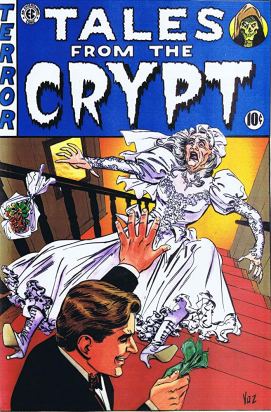
MV5BOThkOTdkYTgtZmIzMS00MWVkLWJlNjEtZjAyZTI3OWI0NTE5XkEyXkFqcGdeQXVyODI0NDgwNjA@._V1_SY1000_CR0,0,657,1000_AL_.jpg

Coming back to the straight-up terrifying end of things, we have a darkly suspenseful and shocking season four opener about a charming, yet devious conman (Treat Williams) who seduces wealthy old women into marrying him, all so that he can kill them and pilfer their considerable fortunes. The latest in his line of prey is widow Effie Gluckman (Frances Sternhagen), whose initial skepticism is soon culled by Howard’s humble facade. Smoothly as his scheme seems to be running, however, there’s someone or something fully aware of the mountain of corpses Howard has accumulated, and it soon becomes apparent that even the most devilish of charmers can’t run from their sins forever.
This episode of “Tales from the Crypt” actually served as the directorial debut of actor Tom Hanks, which is especially remarkable considering how on-point the cinematography of this one is. Hanks and the rest of the episode’s crew make great use of darkly-lit suspense and gore shots, and the true terror of the widows’ predicaments are expertly conveyed with the utilization of sickening reaction shots and keenly-executed perspective. Removing that, however, this one is still a great karmic horror story, with Treat Williams delivering a contemptible character in Howard Price. His shameless characterization, highlighted in a scene where he claims he is doing each widow a favor before their deaths, makes the inevitable fate of Effie all the more tragic and gut-wrenching, as does Frances Sterhagen’s turn as the heartbroken and vulnerable old woman. Also, despite taking an abruptly supernatural turn, the twist ending of this episode provides a textbook case of the series’s brand of poetic justice, and chances are good that you’ll be cheering for the karma on display… if you’re not wincing at how gory the end result is. And speaking of gory twists…

5. Top Billing
ECvzFCdWkAEV4BU.jpg

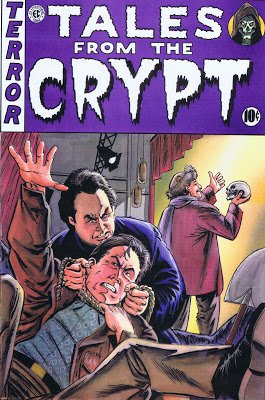
Less a straight-up horror at first glance and more a psychologically driven cautionary tale on the dangers of career entitlement, this episode, “Top Billing” deserves special mention for being yet another example of a normally comedic actor displaying some surprising dramatic chops as the star of a character study. The normally comical Jon Lovitz plays Barry Blye, a struggling actor in competition with a cocky commercial star (Bruce Boxleitner) for the lead role in a local theater’s production of “Hamlet”. Desperate for his big break and knowing his rival is likely to make a big role, Barry resorts to drastic extremes in order to keep him out of the cast and secure his own career, only to find out there’s more risk involved in auditioning than he could have ever imagined.
This excellent season three entry doesn’t start becoming a straight horror/thriller until the second half, but its narrative works in the same way most of the best episodes of “Tales From the Crypt” do- its commitment to dramatic tension. Adding onto that heavier emphasis on personal drama is the on-point acting of Jon Lovitz, whose portrayal of Barry’s struggles and desperation will illicit natural sympathy from audiences, at least until he starts dipping to extreme lows. Bruce Boxleitner also deserves some credit as the commercial actor, Winton Robbins, for perfectly embodying the superficial charm of cocky up-and-comers of this nature, as does John Astin as the theater director, who is laughably entertaining as a gloriously hammy auteur drunk on his own pretentiousness. Still, while the episode’s story is more than content in satirizing the acting industry, the horror end of things really settles in when Barry becomes willing to do anything (i.e. murder) to further his career, and his final fate upon securing literally deadly role sends a haunting message about how entitlement can corrupt even the most earnest and dedicated of people in their craft. As one with personal aspirations of breaking into the entertainment industry on various levels, this one personally hit close to the vest for me, and if this were a purely personal list of episodes, “Top Billing” would easily land somewhere in the top three. Still, if I may, I’d like to bring us back to the topic of suspense and atmosphere…

4. The New Arrival
MV5BMzRmZmY2YmYtYjc3ZS00NWQ2LThlOWEtM2ZmMTZkYjQ2NDQ4XkEyXkFqcGdeQXVyODI0NDgwNjA@._V1_SY1000_CR0,0,647,1000_AL_.jpg

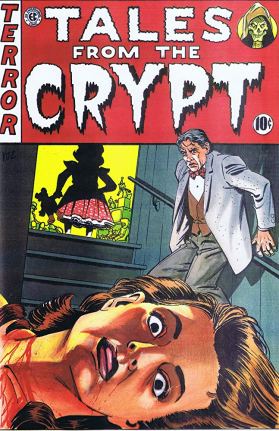
This one is EASILY my personal favorite among the episodes of the fourth season, an already-excellent chapter in “Tales From the Crypt” containing classic episodes like “Split Second”, “None But the Lonely Heart”, “Easel Kill Ya”, and “Top Billing”. While those episodes touched upon rather specific brands of horror, however, “The New Arrival” earns extra points for evoking the kind of eerie, unsettling suspense that will shake all but the most hardened of horror enthusiasts. It tells the story of Dr. Alan Goetz (David Warner), a snobby radio psychologist at risk of loosing his time slot on the airwaves to a popular shock jock. To prevent this, he agrees to a live recorded session with the daughter of the show’s most frequent caller (played by Poltergeist actress Zelda Rubenstein) at her home. What starts out as a surefire way to save the show, however, turns into a twisted trap inside a decrepit old house occupied by the eccentric mother and the ghastly cries of a daughter that remains yet unseen…
The setup of this one is typical of “Tales From the Crypt”, as Dr. Goetz is exactly the kind of smarmy know-it-all in need of karmic education (especially considering his neglectful, pseudo-psychological approach to his field), and David Warner gives an appropriately dour performance. What makes “The New Arrival” stand out, however, is the suspense it builds up through atmosphere and surreal horror. The house is an old fashioned, chewing gum-covered husk of a home that wouldn’t be out of place in an early Tim Burton film, and its inhabitant, Felicity’s mother, is a polite, hospitable, yet clearly disturbed old woman made all the more unnerving by Zelda Rubinstein’s perfect portrayal. From the get-go, it’s clear that her brand of parenting is directly responsible for Felicity’s psychotic, borderline bestial behavior, but every second on screen becomes a testament to her underlying craziness thanks to the nuance of Rubenstein’s acting. That buildup, however, should not imply the inevitable twist goes in any predictable direction, and “The New Arrival’s” payoff to that warped buildup makes it a definite classic. Which is saying something, considering the next entry…

3. Yellow

Yellow-38.jpg

The only thing keeping “Yellow” from the top spot is its deviation from typical horror and the element of personal judgment. Otherwise, this one’s a perfectly executed war-themed episode that deserves credit for its sheer ambition and production value, as it’s the only episode of “Tales From the Crypt” to be an hour-long special. This grand finale to the show’s third season is a more grounded war story about Lieutenant Martin Kalthrob (Eric Douglas), who pleads his father, General Kalthrob (Kirk Douglas) to grant him a discharge. Being a hardened man of war, the General refuses but promises him a transfer upon the completion of a special mission. When that mission comes about, however, Martin abandons his posts and comrades, dooming him to the designation of being “Yellow” and worthy of a court marshal and firing squad execution.
As mentioned before, the production values and gritty direction of Robert Zemeckis deserve special mention for how bold a turn they allowed the series to take for this one episode. If the time frame weren’t as constricted as it was, one could very well have seen potential in “Yellow” as a feature-length film. Beyond that, however, this episode should be lauded for its commitment to a more visceral and grounded type of horror beyond that of the monsters so common throughout the shows run: the Hell that is war. Punctuating this is magnificent character chemistry between father and son, as the legendary Kirk Douglas does wonders at conveying his inner conflict beneath the facade of a poor man’s Patton while Eric Douglas gives a pitiable performance that, along with the circumstances of his enlisting, makes his subsequent cowardice all the more understandable. “Yellow” isn’t just a good episode of “Tales From the Crypt”, it’s transcendent, and while I have more personal picks for episodes more emblematic of the show as a whole, it’d be entirely dishonest not to include it on this list.

2. Confession

MV5BZDg0Y2VkYTEtNTNhYi00YTM0LTliN2MtMzg3OWFhZTAzZDcxXkEyXkFqcGdeQXVyNjQyNTkzNg@@._V1_SY1000_CR0,0,677,1000_AL_.jpg

“Tales From the Crypt’s” seventh and final season was a drab, boring slog of a finale to a show all about the sheer entertainment of horror stories. To that end, I was hesitant to check this one out in spite of trusting the recommendation of that fan of “The Reluctant Vampire”. He told me to expect a great execution of the crime thriller genre with a standout performance from Eddie Izzard. What I couldn’t have possibly expected was one of the best utilizations of the show’s established formula. The story in question? A grisly, camp-free murder mystery in which a seasoned serial killer analyst and interrogator (Ciaran Hinds) is pitted against a pompous horror film writer (Eddie Izzard) accused of the decapitations of several women. With the interrogator surrounded on all sides by uninterested police officers and a suspect that refuses legal counsel, this mystery is sure to be one in which the answer is unknown to only himself… for better or worse.
There’s a lot about “Confession” to love, from its utilization of self referential horror tropes without resorting to comedic deprecation to its sense of characterization, especially in regards to its two leads. Pride is a cardinal sin among both interrogator and suspect in this scenario, with Ciaran Hinds’s weathered and cool demeanor offsetting Eddie Izzard’s brilliantly disturbed, temperamental and egotistical performance. While investigator Jack Lynch is prideful in the sense that he’s sure he’s seen every killer, Eddie Izzard’s Evans is so confident in his “knowledge” of killer cliches that he’s counting on that as the “smoking gun” of his innocence. The true culprit is one I won’t spoil, but “Confession” should still be praised for having that rare brand of twist ending that works even better upon repeated viewings, as well as for the aforementioned mastery of tone and character voice. So, what could possibly have topped this tangled web of horrific intrigue?

1. Carrion Death
MV5BNTY2YjBiZDAtZWJiNy00MzA1LWE1YWQtMTVjZmU4YzZlNTE3XkEyXkFqcGdeQXVyNjQyNTkzNg@@._V1_.jpg

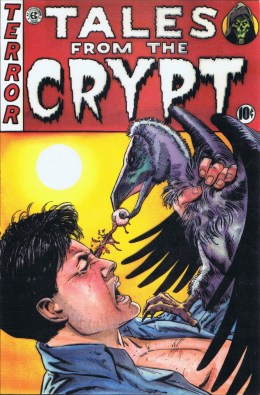
“Carrion Death” is the kind of horror story that’s so simple, it defaults into nightmarish perfection. It’s not necessarily the best written, or the scariest, or even the best one direction-wise, but its execution of a practically pedestrian narrative is made legendary by everything great about “Tales From the Crypt”- dark, poetic, justice, an almost laughably despicable lead, and the kind of direction and framing that’s evocative of an inescapable nightmare. It stars Kyle MacLachlan as Earl Raymond Diggs, an unapologetic serial killer on a dogged path towards the Mexican border with the law hot on his trail. Good news? His pursuer, a lone police officer, is dead by his hands. Bad news? He’s handcuffed to the cop and forced to walk the harsh desert with disaster after disaster crossing his path, all while a mysterious and clearly famished vulture awaits the moment that the inevitable cannot be delayed any further.
Silly as this episode can be (the tenacity of that vulture requires a lot of disbelief to be suspended), this episode’s approach to its admittedly bare-bones narrative makes it the perfect kind of episode to start a binge of horror this Halloween season. As it unfolds, it becomes less a story of a killer on the run from the law and more a fable about one sinner’s futile attempts to run from death itself. That’s all I’ll say, since I desperately want you all to check this and the rest of the series out, but I’m confident I did well to kick off the season. Drink deeply, readers…
396833882365871088ba351e6c01a7ab.jpg

October is here.


Rich Reviews- The Lion King (2019) and the Sad Neglect of Animation

the-lion-king-2019-review-2-1280x720.jpg

I almost didn’t want to review this one. Almost.

Over the last few years, much of Disney’s recent filmography has consisted of live-action remakes or spin-offs of films in its animated canon, and it’s clear from the latest entry that less and less effort is actually going into them. Almost all of these remakes (barring the recent live-action “Jungle Book” movie) are fairly bad in their own ways, since they tend to completely derail the achievements present in the story beats of the original films, but I’ll at least give them credit for trying to do something different from the originals. The remake of “Cinderella” may have undermined its supporting cast and misunderstood what made the title character work in the original, but it at least tried to add some character of its own. The remade “Beauty and the Beast” is a truly plastic, shallow, and misguided piece of cinema that does not get the importance of subtlety and characterization, but that film at least thought it was adding dimension and feminist encouragement to the narrative. Seeing trailers for the 2019 remake of “The Lion King”, however, is basically seeing the movie itself: CGI visuals that cease to look impressive the second you remember the breathtaking animation of the original, redone versions of the famous songs that are no doubt making a pretty penny for Walt Disney Records, and a story that also ceases to have a reason to be told when its been told so much better in the original. In short, “The Lion King 2019” is exactly the kind of shot-for-shot remake and corporate product that earned Gus Van Sant ridicule when he chose to redo “Psycho”, and I say “corporate product” instead of “misguided remake” because the latter would imply that there was any bit of passion injected into this film beyond the admittedly impressive performances of the musicians in the soundtrack. The fact that they chose to remake “The Lion King” of all things (especially given its status as one of the most lauded examples of traditional animation) was bad enough, but the execution makes the pointlessness of the endeavor stand out all the more. Really, there’s only one purpose this movie could serve beyond continuing a steady stream of Disney profit, and it’s a purpose that does the idea of this kind of remake no favors. If you’ll indulge me, I’ll soon explain after the typical rundown.

The creatures of Africa’s animal kingdom are in the midst of a joyous era following the birth of the lion pride’s crown prince, Simba (voiced in adulthood by Donald Glover). Standing in defiance of this joy, however, is Scar (Chiwetel Ejiofor), the brother of King Mufasa (James Earl Jones), who plans a coup with a tribe of hyenas to kill his brother, leave Simba for dead and usurp the throne. Tricked into believing he was responsible for Mufasa’s death following a stampede, Simba flees Pride Rock and is taken in by the meerkat/warthog duo of Timon and Pumbaa (Billy Eichner and Seth Rogen), who teach him to put the past behind him. But when Scar’s rule renders the savannas a wasteland and the food picking slim, it soon becomes clear that Simba cannot fight his destiny to return home, reclaim the throne from Scar, and save his family and friends from perishing under his uncle’s tyrannical rule.

As is typical with this sort of review, I shall attempt being positive with my prerequisite list of things I enjoyed about the film.

  • Seth Rogen was a good Pumbaa and the only one sounding like he had fun in the recording booth.
  • The film features a charming cover of “The Lion Sleeps Tonight”.

Talking about why this film doesn’t work seems fairly straightforward at first, considering how little is changed and how deeply the remake is hurt by its desires to be more “realistic”. What’s especially apparent about this change in aesthetic is how it benefits the emotional impact of each story beat (that is to say, not in the slightest). Now, one could argue that diminished pathos is true of every live-action remake thanks to the change in medium, but this is especially bad for a movie like “The Lion King”, a film that was already on the simpler side of narratives and whose main appeal was grandiose spectacle and raw emotion. Thanks to its commitment to photo-realism, however, the visual elements that served as the glue that held the story together is nonexistent. Gone are the splashes of warm colors accompanying the sunrise at Pride Rock, replaced with the kind of drab desert atmosphere that wouldn’t be out of place in a “Mad Max” movie, and the dark atmosphere of set-pieces like the Elephant Graveyard and Rafiki’s woods are also replaced by the most basic of color palettes. Also gone are the facial expressions that once conveyed all of the joy, pain, and triumph of Simba’s fall and rise back to the throne, and as a result, what once was a crushing scene of a young Simba hopelessly weeping over the body of his fallen father becomes mere pantomime on the faces of rigid, expressionless animals that completely suck the pathos out of the scene. Beyond the facial expressions, the character designs themselves are simply worse, with every hyena character being basically indistinguishable and the attempts to recreate certain designs in this style (Scar’s in particular) coming off as cringe-worthy. Worse yet, the script seems to be attempting to make up for the lack of vivid, nonverbal expression from the characters by adding more dialogue where it wouldn’t have otherwise been needed, such as in Scar’s final moments. What once was a quick exchange between the main villain and his angered servants right before the atmospheric moment of his demise is now stretched out to slowly explain how the hyenas feel about being thrown under the bus before he’s taken down. Finally, the way in which “realism” killed this remake is through the vocal performances. While the idea of the actors’ direction this time around may have been to make the characters seem more grounded, it’d be much more intellectually honest to simply say that the actors sound completely bored. Try as he might to act around the awful design, Chiwetel Ejiofor completely fails to capture the essence of Scar, whose flamboyant demeanor and operatic voice courtesy of Jeremy Irons made the character an iconic villain in the original. Even Donald Glover, someone I know to be an energetic and engaging performer and musician, sounds completely jaded here, and fails to sell the kind of vulnerability and eventual determination that Matthew Broderick did a much better job with before. This is saddening to me, because they could have given a force of personality like Glover some real presence by giving him better direction and more musical numbers, like those from the Broadway version of “The Lion King”. That kind of suggestion, however, comes with the naive assumption that any artistic choices were involved in this misguided, soulless mess.

As much as I hate playing the part of the snooty critic, I could honestly go on and on. I could thumb my nose at everything from the bland cinematography, the shortened, utterly inferior musical numbers, the groan-worthy attempts at self-referential humor, and how the whole film ended up being exactly the kind of corporate retread for the sake of maximum brand monetization. However, the existence and failing of the “Lion King” remake plays into a problem that has hung over the film industry like a bad smell: the perceived “inferiority” of animation.

Hollywood as a whole has had a long and bitter history of dismissing animation as “kid’s stuff”, and the existence of this and other Disney remakes is indicative of a standardized attitude that “more realistic” is equivalent to “more valid”. It’s a fairly arrogant stance on films, and one that I think does no favors to the art of film making as a whole, but these remakes are not the biggest problems by a long shot. It was at the 2015 Academy Awards, during which the winner for “Best Animated Feature” was announced, that had me concerned, as then-host Dwayne Johnson declared “Big Hero 6” an exemplary entry in the animation “genre”. The implication there is that animation is not a medium capable of versatile storytelling, and could only be the home of children’s movies. That line of thinking completely dismisses the sort of atmospheric and artistic identities that animation has granted some of the most beloved films in the history of the medium, such as the romantic intimacy and magic of “Beauty and the Beast” and the grand scope and mysticism of “The Lion King”. Heck, there are examples outside of Disney that convey the power of animation, such as the sense of 50’s period authenticity in “The Iron Giant”; the gritty surrealism of “Rango”, and the presence of calligraphy and classic Japanese art in Miyazaki films like “Spirited Away” and “Princess Mononoke”. Attempts to recreate those kinds of aesthetics in live-action would be misguided and awkward at best and completely dismissive and bland at worst. None of this is to say that I consider one medium better than the other. In fact, I’m arguing that the opposite sort of attitude be promoted here. Animation should be the kind of thing that stands side by side with more conventional filming methods, as both are capable of delivering stories that really speak to audiences and give them something to remember.

Good art doesn’t come from making more “realistic” or “legitimate” versions of animated films, it comes from acknowledging that no one method of film making is more “legitimate” than another. Disney is forgetting how to play to its own strengths, and the longer we keep encouraging this sort of narrow-minded rehashing, the worse off the world of film will be.

If you like this review, and have a request for review, please consider supporting me on Patreon via the link below:

https://www.patreon.com/user?u=23167206

Rich Ruminations- Roy Batty’s Defiance of Conventional Villainy

rutger-hauer-roy-batty-1200x680.jpg

A few weeks ago, on July 19 2019, Dutch character actor Rutger Hauer passed away at the age of 75 following an as-of-now unspecified illness, and it would take at least three posts unto themselves in order to truly encapsulate what a loss this is for the world of cinema. Throughout his career, Hauer had burrowed his was into the hearts and minds of film-goers everywhere through his portrayal of some of the most iconic characters in pop culture (mainly villains), and since his transition to American films from Dutch television, he had done enough work to be considered a sort of unsung hero among actors of his era. Even while he was type casted into villainous roles following a certain timeless classic of 80’s sci-fi, the man was guaranteed to add dimension, charisma, and nuance to any character he was assigned. As such, I was very deliberate (hesitant, really) in putting out a sort of tribute post, since my intention was never to simply write over a man’s grave. In other words, I hope I’m able to properly honor Rutger Hauer through this exploration of what’s considered his most iconic character- “Blade Runner’s” Roy Batty.

WARNING: The following is a heavily analytical post that contains SPOILERS for the plots of the following movie

  • Blade Runner (1982)

Released in 1982 in the wake of heavy studio meddling and re-editing, Ridley Scott’s “Blade Runner” was something of a misunderstood piece of cinema, and in spite of its current status as a beloved classic among philosophical science fiction films, its initial theatrical release was met with mixed reviews, with most audiences taking umbrage with its slow pace and overemphasis on atmosphere. Of course, both of those things would later be seen as immortalizing achievements for “Blade Runner”, but that larger misunderstanding of the film’s intentions as a whole rang especially true for audience’s views on the characters, particularly the protagonist and antagonist. In an interview concerning the story of the video game “Detroit: Become Human” (also concerning the plights and oppression of androids), Quantic Dream CEO and lead developer David Cage once said that his game’s story differs from that of “Blade Runner” by virtue of the fact that “the androids are the good guys” in his story. To make such a clear-cut statement on the morality of the film’s characters, however, is to stand as completely emblematic of the kind of misunderstandings still misdirected at “Blade Runner”. Speaking as one who took multiple views of “Blade Runner” to truly grasp its victories as an artistic achievement, I can say that I was also guilty of expecting a straightforward sci-fi action movie with a hard boiled Harrison Ford as the unquestionable hero during my first viewing.

I certainly wasn’t expecting to weep for the villain.

This “villain”, Roy Batty (Rutger Hauer) is one of several rogue “replicants” (androids) attempting to escape a post-nuclear Los Angeles, unique among the crew he’s assembled for being designed with combat in mind. He’s terrifyingly stronger than the average human, but also possesses an even sharper mind, capable of seamless tactics and keen manipulation on the fly. He is also, in essence, a traumatized veteran, so utterly shaken by the destruction he’s witnessed on duty that he only wants to escape the role assigned to him and extend the life he wants to carry out in peace. When he arrives on Earth and finds out that extending that programed lifespan is impossible, Batty becomes determined to do all that fulfills him in that short window of time, killing his creator and attempting an escape before the last of his time is up. In the midst of his struggle, Rick Deckard (Harrison Ford), an LAPD detective and former “Blade Runner” (bounty hunter for rogue replicants) is assigned to “retire” Batty and his motley crew of escaped androids. In any typical narrative, the morality of the situation would be as clear-cut as it sounds- Roy Batty is a murderer and a rebel, and Deckard the hero assigned to put an end to his trail of destruction.

It should be abundantly clear, however, that “Blade Runner” is not your typical narrative, and its focus is on the struggles stifling both sides of the conflict. Whatever black-and-white ethics could be applied to the cat-and-mouse scenario completely evaporate upon the revelation that the replicants have been developing empathy and emotional responses to stimuli over time, and that revelation paints Batty and his crew less as murderous machines than as escaped slaves yearning to live among the humans they share the gift of feeling with. Of course, Batty’s manipulations and murderous actions do make him a villain in this story, but a sympathetic one who one could argue to only be in this situation because of the dehumanizing circumstances imposed onto them by their creators. The philosophical questions raised by these supposed human appliances becoming “fully human” in their own right have been thoroughly explored in countless other academic materials, and thus are not my focus here, but they are crucial to understanding Batty’s way of thinking: Roy Batty had seen the destruction capable of combat, developed emotion, and snapped upon the realization that his is considered an object in the world that he was built into. What aids the narrative in painting Roy Batty as sympathetic are the film’s use of performance and framing, especially as the story draws to a close. Rutger Hauer delivers a performance that seems menacing and calculating at first, but as his struggle unravels and he loses more and more of his replicant friends, it becomes clear that Hauer is just as broken and confused and the detective chasing him, and what could have been an uneven sense  characterization for Batty becomes a soul-crushing tearjerker as Hauer vicariously and perfectly conveys Roy’s anguish. I’m sure that most film buffs, however, are painfully aware of the moment Roy ceases to be a true villain, and that would be in his final moments.

Rick Deckard is dangling from the edge of a building, and visibly slipping. Having mended his own wounds to the best of his ability, Roy Batty is capable of walking. He could use the last of his moments to revel in his victory as his pursuer falls to his death. Instead, he pulls the detective up, reflecting on the mortality he was cursed with, and telling Deckard before he dies:

“I’ve seen things you people wouldn’t believe. Attack ships on fire off the shoulder of Orion. I watched C-beams glitter in the dark near the Tannhäuser Gate. All those moments will be lost in time, like tears in rain. Time to die.”

It’s in that moment, shortly before Batty’s head slowly drops and life leaves him, that the murderous replicant ceases to be a villain in spite of all he has done. Even in the chase leading up to this, the film’s cinematography balances focus between Deckard and Batty in equal measure, with the android’s desperation and pain on as much tragic display as that of the hero. This use of perspective, combined with Hauer’s pitiable expressions and strained delivery, paint a lucid picture of a man (not a replicant, a man) at the end of his rope, desperate to find something worth all of his pain. He leaves Deckard, and by extension, the audience, with that pain to think about as he dies, and Deckard’s internal questions, written plain on his face, are answered only by the cold beating of the rainfall. That Hauer rewrote Batty’s last words before filming also greatly benefits the depth of his character- the comparative brevity of Hauer’s version of this monologue, combined with his final acceptance of death, create a haunting death soliloquy that comes just as quickly as it leaves, rendering audiences in inevitable shock as the runaway murderer comes to terms with his own imminent demise. Words honestly cannot do this sort of poetry justice, so I’ll leave this by stating that Rutger Hauer had contributed to unmistakable art in motion with his performance and collaboration with the film’s crew, and I’m only sad that such a man’s story had to come to such an unforeseen, abrupt end. The pain of one replicant may have slipped by like tears in the rain, but Rutger Hauer certainly will not.

He will always be missed.

Rich Ruminations- Toy Story, Character Arcs, and the Art of the Flawed Protagonist

toy-story-woody-wallpaper-hd-49254-50918-hd-wallpapers.jpg

WARNING: The following is a heavily analytical post that contains SPOILERS for the plots of the following movies-

  • Toy Story (1995)
  • Toy Story 2 (1999)
  • Toy Story 3 (2010)
  • Toy Story 4 (2019)

If there’s one flaw I’ve always kicked myself over as far as this blog is concerned, it’s my ability to truly expand or keep a consistent schedule in the way of content. While I’m aware of the sad truths of my limited time, I see it as  a disservice to myself and what readers I have to duck out for so long after, at most, one or two reviews per month. Still, until recently, I hadn’t been able to meaningfully release content without the aid of theatrical material, and to that end, I thought I would stop sticking to the safe territory of release-based, straightforward reviews and start a new category of film critique/discussion pieces, since I’ve got a lot of things to say about numerous films that goes beyond the questions of “objective” success. To that end, I’d like to introduce each of you to “Rich Ruminations”, starting with a follow-up to a review I did quite some time ago.

In the ramping introduction to my review of “Toy Story 4”, I reflected on the skepticism I shared with the rest of the film-going public towards the perceived necessity of a fourth one of these “Toy Story” films, since I and everyone else agreed that the previous film did just fine at closing the book on the gang of toys that most of us have grown up with (or watched others grow up with). I’ve been following the series since infancy, and there’s an inherent attachment to the series that has colored my expectations and evaluations of each film, to put it mildly. I’d like to think I did a good job at giving this film the benefit of the doubt, but it’d be completely disingenuous to say that I had no apprehension whatsoever about the end result. Still, that other part of me did have faith in the film’s ability to neatly strip the proverbial meat off the bone, and what worked about the fourth movie was that it understood that Woody, the franchise’s protagonist, left plenty of meat fit for a thematic, narrative feast. A lot of people took issue with the fourth film for the diminished screen time of the supporting cast, and while I’m in firm agreement with that criticism (especially in the case of Buzz and Jessie, whose relationship was brushed under the rug), I also think that there’s an element to the series’s overarching narrative that often goes overlooked by nostalgic or purist audiences, and that is the flawed nature of everyone’s favorite cowboy doll. Looking back at the work behind the scenes of the first film was a fascinating bit of research, to say the least, as it revealed that Woody’s character was completely rewritten halfway into production for being irredeemably annoying and arrogant. My fascination with that change, however, lies less in the major differences between both versions of Woody and more in their similarities, because it’s saying something that Woody’s flaws were less pronounced in the final, released film. Woody was everyone’s favorite toy, not simply Andy’s, and for good reason. He was a good leader to the rest of Andy’s (later Bonnie’s) toys, and was part of a lot of fun for both his owners and the audience.

He is also an insecure, cloistered, inflexible, and self-centered protagonist in his worst moments, and I think that is the unsung brilliance of “Toy Story” as a whole.

Part of the genius of Woody’s flaws is how under-stated they are from the outset. We as an audience introduced to Woody from two perspectives- that of Andy, the boy who loves him above all the other toys, and Woody himself. To us, Woody is a simple, sentient toy of simple values- stay close to his owner and keep all the other toys in order. There’s a warmth and a geniality to his character, thanks to this framing and to the charisma given to him by the vocal performance of Tom Hanks, and we’re inclined to love him as much as the cowboy-loving Andy does. His approach to leading the toys during such occasions as Andy’s birthday is portrayed in a sympathetic and relatable light, and it’s telling that we’re given the “no one’s getting replaced” speech from his perspective, since another perspective may reveal the inherent, self-assured smugness of someone who’s been at the top of the pecking order for some time. It’s when Buzz Lightyear enters the picture that we see that Woody has a crippling sense of self-interest, and that Woody could only maintain the facade of a heroic leader so long as threats to his leadership were miles and miles from him. The second Buzz becomes a contestant for Andy’s undivided attention, Woody becomes a veritable green-eyed vulture attempting to return to his comfort zone and keep this supposed intruder out of it.

The worst of it all, of course, being that Buzz himself did nothing wrong.

Lightyear isn’t even concerned with how he’s the favorite, as he is stuck in the programed delusion that he is that “real” Buzz Lightyear and that his is on a mission to save the galaxy. Typical heroes would help Buzz adjust to the existential struggle that inevitably would follow his discovery of being a toy, but it’s not until Woody’s schemes directly endanger Buzz that he starts developing some self-awareness. Even then, he only truly apologizes to Buzz and confesses how great of a toy he is until he’s one morning away from being demolished by the toy-torturing Sid Phillips. Only through a threat of that magnitude is Woody able to realize he was retrieving Buzz for Buzz’s sake, and not for his own, or for Andy’s. The best part of all of this, though, is that he’s still sympathetic in his development, and he’s still got the virtues of loyalty and emotional vulnerability that makes us root for him in spite of his selfishness instead of hating him for the situations he involuntarily instigates. By the second movie, he’s kept that ideal of looking out for his friends, as demonstrated by his daring bid to stop the toys (the squeaky penguin Wheezy in particular) from being sold at a yard sale, but even then, he’s got some growing up to do, since being claimed by a toy collector and meeting the toys made famous by the cancelled hit show “Woody’s Roundup” shows him the previously-ignored risks of sticking with Andy until he grows up. When Buzz and company finally make it to rescue Woody, he’s decided he’d rather be immortalized in a collector’s museum than be with his loved ones and risk the kind of abandonment that Jessie, the claustrophobic cowgirl, suffered as her owner grew. One could argue that Woody was acting out of interest for Jessie, Bullseye and Stinky Pete, but the first movie does show that there’s a bit of the stuffy egotism of Pete inside him, so the impetus behind Woody’s action is not so clear cut.

That thin line between Woody’s virtues and flaws, however, is arguably what makes him one of the most brilliantly written characters in animation, and the truly three-dimensional nature of his character is best exemplified between “Toy Story’s” third and fourth installments. “Toy Story 3”, for instance, shows that he’s grown considerably, and his initial plan to stay in the comfort of Andy’s presence is offset by his clear yearning to be with the other toys in the day care they were donated to. What’s more, he’s directly responsible for the rescue of his friends from that same day care, run by Lotso (Huggin’ Bear), whose dictatorial leadership and all-consuming fear of abandonment could be seen as extreme reflections of Woody’s own micromanaging and superiority complex. Woody simultaneously understood the despair inflicted by being replaced and forgotten by Daisy and the true evil behind his actions toward other toys of his ilk, and Woody’s decision to put himself in that risky position is an unquestionably heroic act for this complicated cowboy. The toys all had their fears and struggles in transitioning to whatever the next chapter was in their lives, and Woody was the one to make it so they had a chapter to turn a page to. Still, going back to the idea of those loose ends in the fourth movie, the writers truly understood the questions left overlooked by the climatic atom bomb that was the third film’s ending, and the makers of the most recent “Toy Story” made sure that the conclusion to Woody’s story had no meat left hanging off that bone.

Woody’s expectations upon being given to Bonnie along with the other toys are basically those of the audience- he and the others are safe with a new owner, and he will get right back where he was when they were with Andy- forgetting the fact that Bonnie is a different child with different interests, and that he isn’t entitled to the favorite spot by virtue of once occupying it. Troubled by this discovery, he essentially resolves to live vicariously through Forky, a toy given sentience when Bonnie created him in kindergarten, and whose longing for the security of trash gets both him and Woody ejected from the van. Forky’s attachment to the trash is one portrayed as suicidal to a degree, but there’s an underlying lack of empathy in Woody’s attempts to keep him out of it. Sure, he has the best of intentions, but starting out, Woody’s protection of Forky is less about giving him a place to be safe and more about finding some place in Bonnie’s development that compensates for his lost position at the top. It’s only until Woody explains his importance to Bonnie by comparing that importance to Forky’s comfort in trash that he is able to break through to him and convince him to be a toy, and that understanding was yet another example of the empathy that Woody was still, even now, still developing.

Still, there’s a core element to Woody’s character that unifies both his sympathetic qualities and his flaws, and that is the struggle to find his purpose independent of the “toy-owner” dynamic. He’s finally able to do so on that journey to get back to Bonnie and the other toys, during which he finds Bo Peep, a porcelain shepherd from the first two movies whose separation from Woody before the third one is finally given full focus. When she reveals she’s been owner-less, “lost”, and on her own track for the last several years, it’s treated as a callous and misguided decision at first, but as Woody comes to see her point of view during the mission to get Forky back to Bonnie, he sees the dilemma of being a “lost toy” from all sorts of perspectives and sacrifices all sorts of things. From giving his voice box to a “Gabby Gabby” doll who previously appeared imposing and creepy due to her desperation to be “whole” and loved to putting Forky’s return to Bonnie above his own, Woody’s character arc reaches a true conclusion in “Toy Story 4”, which makes his ultimate departure from the gang we’ve come to know and love all the more surprising, bittersweet, yet ultimately satisfying and poetic. Woody’s story is, perhaps in one sense, well and truly over with his foray into being a stray “lost toy”, but even if the series decides to continue without him, we as an audience can sense that he is finally comfortable outside the bubble he’s locked himself inside of, especially with the knowledge that he has Bo Peep to love and travel with, and that he’ll always have the memories of (and possibilities of running into) his old friends.

“Toy Story 4” may be a somewhat halfhearted entry in the series in regards to its ensemble cast, and it may undermine some of what was set up in terms of subplots and the development of other characters (Buzz Lightyear in particular), but rather than have that be the final takeaway, I’ll instead confirm why an otherwise unnecessary entry ended up succeeding, and part of why the series is more than just a nostalgic dead horse- Woody is a multi-faceted, flawed, yet endlessly endearing protagonist whose characteristics are exactly what one should build this sort of overarching narrative on. His self-interest and kinder traits never once eclipse each other, and the writers have written the old cowboy doll as one whose actions are thoroughly informed by the makeup of his character.

Still, I’d hate for my own perspective to be the only one on Woody or the “Toy Story” franchise, so I invite any readers of mine to give their own takes on both of these things in the comments below, on Facebook, or on Twitter. I’d love to see what discussions could be bred by this and other “Rich Ruminations” posts.