
Happy Mother’s Day, readers!
Last year on this site, I celebrated Mother’s Day with the typical “top 10” list, paying homage to what I considered some of the most memorable mothers across multiple genres of film. Naturally, I had to switch things up in the interest of avoiding redundancy, but thankfully- I knew almost immediately what the subject of a second Mother’s Day-themed post would be, thanks to the cinematic tastes of my own mother. As far back as I could remember, my mother always cited the John Hughes-scripted movie “Pretty in Pink” as her favorite of all time whenever she was asked, and given the time we had on our hands as of this review’s writing, we both agreed that Mother’s Day would be a great excuse for me to see this romantic comedy classic for the first time. Having seen it, I can definitely see what makes it my mom’s favorite film among others of its genre, because “Pretty in Pink” is definitely a great teen movie among many great teen movies written by Hughes.
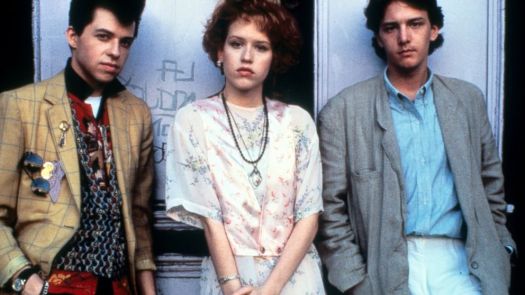
Andie Walsh (Molly Ringwald) is a high school senior with a humble disposition and a humble upbringing, as she lives with her father Jack (Harry Dean Stanton) in a Chicago suburb that’s otherwise populated by preppy, upper-class students. Her life is something of a mixed bag- while she’s got a decent support network in the form of her father, her record store employer Iona (Annie Potts), and her secretly-smitten, wisecracking friend “Duckie” (Jon Cryer), but she’s something of a social outcast at school, and she’s having a hard time finding a date for senior prom. Thankfully, she finds one in the form of a handsome, kind preppy boy named Blane (Andrew McCarthy), and he asks her out shortly after a night on the town together. The days leading up to prom night, however, are not so simple, as Duckie begins oozing resentment for the newly-blooming romance and Blane is lambasted from all sides of his social circle for dating an outcast like Andie. With prom night fast approaching and a tangled web of romantic tension looming over Andie, she’s soon left to decide for herself where her love life is going to go.
One of John Hughes’ greatest strengths as a writer, especially earlier in his career, was his ability to write otherwise-typical high school stories and characters in a natural and relatable style, and it’s that sort of characterization ethos that makes films like “The Breakfast Club”, “Sixteen Candles”, and “Pretty in Pink” stand out among a deluge of 80’s teen movies. With a screenwriter like Hughes behind the film, then, it should come as no surprise that the characterization and dialogue are two of the best strengths of “Pretty in Pink”. Modern films tend to be very hit-or-miss with how they write teenagers and children, but John Hughes, especially in his earlier films, tended to write them flawlessly, and the dialogue in this film is snappy and amusing, but more than that, natural. Actually, “natural” would be the perfect way to describe the characters and their dialogue, and their believable interactions are only further bolstered by the performances of this movie’s cast. The undisputed highlight of this cast is definitely Molly Ringwald, who projects innocence and adolescent moodiness effortlessly as Andie, and delivers flawlessly in both comedic scenes and some of the film’s more somber moments. Andie is a different character entirely from “The Breakfast Club’s” Claire Standish, and Ringwald’s performance in this movie demonstrates that she has a lot of emotional range and could portray more than just the typical snobbish rich girl type. That’s not to say that Ringwald carries this movie’s story alone, however, as the supporting cast is also filled to the brim with character actors delivering endearing performances. There’s not a bad performance among the cast, but the standout performances for me were those of Annie Potts, who makes for a charmingly sarcastic, yet tender mentor figure as Iona, and Jon Cryer as Duckie. Duckie seems like an easy character to despise, being the prototypical “nice guy” that comes to Andie’s aid for romantic rewards and acts like a bitter jerk upon being denied those rewards, but his development across the story makes him a layered character, and Cryer’s acting gives some much-needed dimension to what could’ve been a hopeless romantic comic relief character. “Pretty in Pink” is also made memorable and enjoyable by its iconic soundtrack, filled to the brim with some of the best music of that decade’s new wave scene, with highlights including the title track by the Psychedelic Furs and the iconic romantic ballad “If You Leave” by Orchestral Manoeuvres in the Dark. Such great 80’s music would have been nothing without some keen usage, but if there’s anything director Howard Deutch can do, it’s direct a scene to music, and that sharp direction and use of insert songs make “Pretty in Pink” one of the most memorable “Brat Pack” movies from a film making standpoint.
All of these production elements are in service to a heartwarming, cute teenage romance story that comments on the destructive nature of classism and the separation of social spheres in high school, and that story is populated by likable characters that never lose their charm or authenticity in spite of some being much less sympathetic than others. Still, if I had to criticize one thing about “Pretty in Pink”, it’d be the ending and the resolution to the relationship conflicts presented by the narrative. While the prom scenes themselves are not poorly executed or uncompelling in the slightest, part of me wishes more time was focused on the dynamics of Andie and Blane’s relationship, since their interactions toward the end feel fairly rushed. To that end, the conflict surrounding the love interests’ separate social classes seems somewhat forced and under-cooked in places, as if that main plot line was fighting for screen time with the side characters and the B-plot about Andie’s father struggling to find work. Still, since the movie’s aforementioned strengths are as endearing and well-executed as they are, I feel safe in saying that criticism is a comparatively minor one in the grand scheme of things.
With that in mind, anyone thinking about revisiting or introducing themselves to “Pretty in Pink” should definitely do so. It’s sweet, funny, populated by likable characters and great new wave music, and fueled by a lot of heart. Thanks for introducing me to this 80’s classic, mom.
 Rich Reviews