
If there’s anything that Disney’s cinematic history and filmography have taught me over years of analyzing films, it’s that audiences at large seem fairly unwilling to accept small successes when it comes to their films. That’s not to say that every film considered “low-tier Disney/Pixar” by critics was criticized unfairly upon its release, but more often that not, I’ve seen both mainline Disney and Pixar films be smart, unique, and valuable animated films in their own right… only to be dismissed by critics as “mediocre” or “just okay” because they either stray from outwardly original territory, follow typical story beats, or fail to break arbitrary box office records (see “Oliver and Company” and “Treasure Planet”, among many others, for proof positive of that). A Disney or Pixar movie, in other words, is not allowed to be flawed, lest a certain subset of their audience lambast the movie as a step down for the company as a whole. Still, while I was no stranger to this critical mindset in my early days of film critique, I don’t consider such a mindset to be productive criticism, and I’m okay with a movie being a little familiar if it means I can enjoy something that the story can call its own. With that in mind, I’d like to take a look at “Onward”, a movie that got decent reviews during its brief theatrical run, yet whose flaws and story beats have rendered the film a “disappointment” by the aforementioned purists. Is “Onward” a masterpiece whose theatrical success was cut tragically short by the ongoing pandemic, or do the people calling the film a mediocre Pixar entry have a point about its flaws? Well, let’s begin with the story…
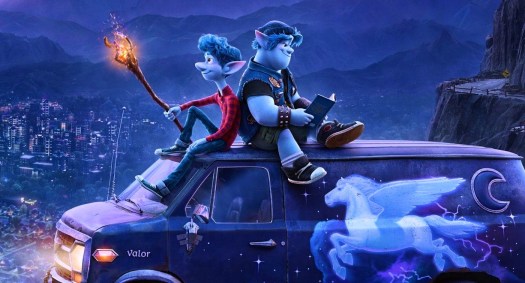
Ian Lightfoot (Tom Holland) is a meek and perpetually anxious elf attending high school in a world populated by all sorts of fantasy races mythical creatures. This world, once teeming with magic, is now in an industrialized, urban age resembling our own, to the point where the presence of magic and the age of adventurers are all but forgotten. All of this changes, however, when his mother Laurel (Julia Louis-Dreyfus) shows Ian some posthumous 16th birthday gifts from his late father- a wizard’s staff, and a magic gem. With these gifts comes the incantation for a special magic spell- one that will resurrect his father for a day and allow them the bonding time that illness never allowed them to have. The spell goes horribly awry, however, only restoring Ian’s father from the waist down, and forcing Ian to embark on a journey to find a new gem to complete the spell. Thankfully, he’s not alone, with his older brother Barley (Chris Pratt), convinced of the historical accuracy of his favorite fantasy role-playing games, eager to guide the skeptical Ian towards the gem that will revive their father before their time is up. The journey, of course, is far from free of danger, and as they set out, Laurel resolves to follow them, recruiting the help of a retired adventurer and tacky restaurant owner known as The Manticore (Octavia Spencer).
As one could probably guess by the premise, the story and the progression thereof is fairly standard Pixar affair, with an unlikely duo setting out to find something of personal, yet deceptively overarching significance, albeit with a traditional fantasy twist. That story, however, is not as meaningful a flaw of “Onward” as that fantasy twist is, because the world building of this urban fantasy setting is a bit under-cooked. This Tolkien-esque world’s transformation from an enchanted realm to a modern urban setting with elves in place of humans is as straightforward and brief as it sounds, and I feel like they could have implemented the fantasy angle a bit more actively into the urban setting. While the team of magic being overshadowed by the conveniences of technology is given a pointed setup, there’s a lot of potential for portraying creatures like centaurs, fairies and ogres in a setting like this that I felt was under-utilized. In other words, the setting, while gorgeously animated and well-realized by some excellent art direction and designs, feels like little more than just a contemporary urban setting with some fantasy nods here and there.
As one also could have guessed by the telegraphed intro to this review, however, very little of the flaws present in the familiar story and setting matter, if any at all, to “Onward’s” strengths as a film. What “Onward” lacks in an original premise, it makes up for in wonder and sheer, unadulterated heart. While the world itself is a little half-baked, its implementation on the visual side of things is colorful, beautifully animated, and keenly designed, with the artists and animators lending some wonderful visual twists to the tried and true elf and monster designs of similar fantasy films. The animation itself is also a great strength of the visuals, with the timing during the sparingly used comedy scenes being on-point and well utilized. “Dull” is simply not a word you can use to describe the look and feel of “Onward”, as the journey Ian and Barley take is one through a wondrously crafted world full of subtle hints to the magic buried beneath the years of modernization. Speaking of that journey, the characters are also instantly likable in spite of all filling familiar roles, and they come off as much more three-dimensional and human than they would in lesser animated films. Ian, for instance, may seem like the typical introverted skeptic allergic to taking risks, but he’s voiced perfectly by Tom Holland, and the story works in conjunction with the stellar animation and acting to show viewers just how deeply his father’s death affected his ability to grow up. Thus, his progression along the journey to the gem feels all the more believable, and his growth as a protagonist is made all the more endearing by the chemistry he shares with his brother Barley. Barley, like Ian, could’ve easily been annoying comic relief in a different story, but like Ian, he’s excellently voiced, as Chris Pratt is both endearing and chuckle-worthy whenever he’s being the adventurous goofball, but surprisingly even more effective when things get dramatic. Also helping Barley’s likability as a character is his empathy, as his eagerness for adventure is never one that overshadows his protective instincts as an older brother. In fact, the cast as a whole is probably the film’s greatest strength, as there’s not a single unlikable character among the bunch.
What I believe to be the film’s true crowning achievement, however, is the grand journey at the center of its story. Unlike with many contemporary animated films, there are few contrivances for the sake of conflict, nor is there any true villain to set Ian and Barley back. Rather, the primary obstacles in their path are natural hazards and the complications of Ian and Barley’s relationship, and the journey is a well-written story of a young man coming to terms with the legacy of a father he never got to meet, and the importance of fantasy as a means of inspiring creativity and flexibility. In other words, the admittedly familiar and terse fantasy elements are not fatal flaws to a film like “Onward”, since the story is intimate, heartfelt, and impactful enough that it doesn’t need to break too much ground.
As such, “Onward” is a very good film, and possibly could be called “great” for being as heartfelt, wondrous, and beautiful as it is. It’s not nearly as close to flawless as some of the rest of Pixar’s filmography, but for telling a touching and exciting story starring two of the most realistically written brother characters in animated film, “Onward” deserves to be enjoyed at home, be it by a family or just a viewer looking for a good urban fantasy adventure.
 Rich Reviews