
I almost didn’t want to review this one. Almost.
Over the last few years, much of Disney’s recent filmography has consisted of live-action remakes or spin-offs of films in its animated canon, and it’s clear from the latest entry that less and less effort is actually going into them. Almost all of these remakes (barring the recent live-action “Jungle Book” movie) are fairly bad in their own ways, since they tend to completely derail the achievements present in the story beats of the original films, but I’ll at least give them credit for trying to do something different from the originals. The remake of “Cinderella” may have undermined its supporting cast and misunderstood what made the title character work in the original, but it at least tried to add some character of its own. The remade “Beauty and the Beast” is a truly plastic, shallow, and misguided piece of cinema that does not get the importance of subtlety and characterization, but that film at least thought it was adding dimension and feminist encouragement to the narrative. Seeing trailers for the 2019 remake of “The Lion King”, however, is basically seeing the movie itself: CGI visuals that cease to look impressive the second you remember the breathtaking animation of the original, redone versions of the famous songs that are no doubt making a pretty penny for Walt Disney Records, and a story that also ceases to have a reason to be told when its been told so much better in the original. In short, “The Lion King 2019” is exactly the kind of shot-for-shot remake and corporate product that earned Gus Van Sant ridicule when he chose to redo “Psycho”, and I say “corporate product” instead of “misguided remake” because the latter would imply that there was any bit of passion injected into this film beyond the admittedly impressive performances of the musicians in the soundtrack. The fact that they chose to remake “The Lion King” of all things (especially given its status as one of the most lauded examples of traditional animation) was bad enough, but the execution makes the pointlessness of the endeavor stand out all the more. Really, there’s only one purpose this movie could serve beyond continuing a steady stream of Disney profit, and it’s a purpose that does the idea of this kind of remake no favors. If you’ll indulge me, I’ll soon explain after the typical rundown.
The creatures of Africa’s animal kingdom are in the midst of a joyous era following the birth of the lion pride’s crown prince, Simba (voiced in adulthood by Donald Glover). Standing in defiance of this joy, however, is Scar (Chiwetel Ejiofor), the brother of King Mufasa (James Earl Jones), who plans a coup with a tribe of hyenas to kill his brother, leave Simba for dead and usurp the throne. Tricked into believing he was responsible for Mufasa’s death following a stampede, Simba flees Pride Rock and is taken in by the meerkat/warthog duo of Timon and Pumbaa (Billy Eichner and Seth Rogen), who teach him to put the past behind him. But when Scar’s rule renders the savannas a wasteland and the food picking slim, it soon becomes clear that Simba cannot fight his destiny to return home, reclaim the throne from Scar, and save his family and friends from perishing under his uncle’s tyrannical rule.
As is typical with this sort of review, I shall attempt being positive with my prerequisite list of things I enjoyed about the film.
- Seth Rogen was a good Pumbaa and the only one sounding like he had fun in the recording booth.
- The film features a charming cover of “The Lion Sleeps Tonight”.
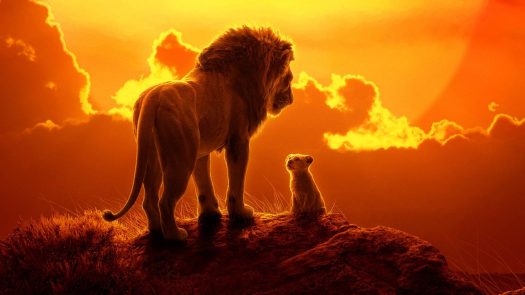
Talking about why this film doesn’t work seems fairly straightforward at first, considering how little is changed and how deeply the remake is hurt by its desires to be more “realistic”. What’s especially apparent about this change in aesthetic is how it benefits the emotional impact of each story beat (that is to say, not in the slightest). Now, one could argue that diminished pathos is true of every live-action remake thanks to the change in medium, but this is especially bad for a movie like “The Lion King”, a film that was already on the simpler side of narratives and whose main appeal was grandiose spectacle and raw emotion. Thanks to its commitment to photo-realism, however, the visual elements that served as the glue that held the story together is nonexistent. Gone are the splashes of warm colors accompanying the sunrise at Pride Rock, replaced with the kind of drab desert atmosphere that wouldn’t be out of place in a “Mad Max” movie, and the dark atmosphere of set-pieces like the Elephant Graveyard and Rafiki’s woods are also replaced by the most basic of color palettes. Also gone are the facial expressions that once conveyed all of the joy, pain, and triumph of Simba’s fall and rise back to the throne, and as a result, what once was a crushing scene of a young Simba hopelessly weeping over the body of his fallen father becomes mere pantomime on the faces of rigid, expressionless animals that completely suck the pathos out of the scene. Beyond the facial expressions, the character designs themselves are simply worse, with every hyena character being basically indistinguishable and the attempts to recreate certain designs in this style (Scar’s in particular) coming off as cringe-worthy. Worse yet, the script seems to be attempting to make up for the lack of vivid, nonverbal expression from the characters by adding more dialogue where it wouldn’t have otherwise been needed, such as in Scar’s final moments. What once was a quick exchange between the main villain and his angered servants right before the atmospheric moment of his demise is now stretched out to slowly explain how the hyenas feel about being thrown under the bus before he’s taken down. Finally, the way in which “realism” killed this remake is through the vocal performances. While the idea of the actors’ direction this time around may have been to make the characters seem more grounded, it’d be much more intellectually honest to simply say that the actors sound completely bored. Try as he might to act around the awful design, Chiwetel Ejiofor completely fails to capture the essence of Scar, whose flamboyant demeanor and operatic voice courtesy of Jeremy Irons made the character an iconic villain in the original. Even Donald Glover, someone I know to be an energetic and engaging performer and musician, sounds completely jaded here, and fails to sell the kind of vulnerability and eventual determination that Matthew Broderick did a much better job with before. This is saddening to me, because they could have given a force of personality like Glover some real presence by giving him better direction and more musical numbers, like those from the Broadway version of “The Lion King”. That kind of suggestion, however, comes with the naive assumption that any artistic choices were involved in this misguided, soulless mess.
As much as I hate playing the part of the snooty critic, I could honestly go on and on. I could thumb my nose at everything from the bland cinematography, the shortened, utterly inferior musical numbers, the groan-worthy attempts at self-referential humor, and how the whole film ended up being exactly the kind of corporate retread for the sake of maximum brand monetization. However, the existence and failing of the “Lion King” remake plays into a problem that has hung over the film industry like a bad smell: the perceived “inferiority” of animation.
Hollywood as a whole has had a long and bitter history of dismissing animation as “kid’s stuff”, and the existence of this and other Disney remakes is indicative of a standardized attitude that “more realistic” is equivalent to “more valid”. It’s a fairly arrogant stance on films, and one that I think does no favors to the art of film making as a whole, but these remakes are not the biggest problems by a long shot. It was at the 2015 Academy Awards, during which the winner for “Best Animated Feature” was announced, that had me concerned, as then-host Dwayne Johnson declared “Big Hero 6” an exemplary entry in the animation “genre”. The implication there is that animation is not a medium capable of versatile storytelling, and could only be the home of children’s movies. That line of thinking completely dismisses the sort of atmospheric and artistic identities that animation has granted some of the most beloved films in the history of the medium, such as the romantic intimacy and magic of “Beauty and the Beast” and the grand scope and mysticism of “The Lion King”. Heck, there are examples outside of Disney that convey the power of animation, such as the sense of 50’s period authenticity in “The Iron Giant”; the gritty surrealism of “Rango”, and the presence of calligraphy and classic Japanese art in Miyazaki films like “Spirited Away” and “Princess Mononoke”. Attempts to recreate those kinds of aesthetics in live-action would be misguided and awkward at best and completely dismissive and bland at worst. None of this is to say that I consider one medium better than the other. In fact, I’m arguing that the opposite sort of attitude be promoted here. Animation should be the kind of thing that stands side by side with more conventional filming methods, as both are capable of delivering stories that really speak to audiences and give them something to remember.
Good art doesn’t come from making more “realistic” or “legitimate” versions of animated films, it comes from acknowledging that no one method of film making is more “legitimate” than another. Disney is forgetting how to play to its own strengths, and the longer we keep encouraging this sort of narrow-minded rehashing, the worse off the world of film will be.
If you like this review, and have a request for review, please consider supporting me on Patreon via the link below:
 Rich Reviews