
WARNING: The following is a heavily analytical post that contains SPOILERS for the plots of the following movies-
- Toy Story (1995)
- Toy Story 2 (1999)
- Toy Story 3 (2010)
- Toy Story 4 (2019)
If there’s one flaw I’ve always kicked myself over as far as this blog is concerned, it’s my ability to truly expand or keep a consistent schedule in the way of content. While I’m aware of the sad truths of my limited time, I see it as a disservice to myself and what readers I have to duck out for so long after, at most, one or two reviews per month. Still, until recently, I hadn’t been able to meaningfully release content without the aid of theatrical material, and to that end, I thought I would stop sticking to the safe territory of release-based, straightforward reviews and start a new category of film critique/discussion pieces, since I’ve got a lot of things to say about numerous films that goes beyond the questions of “objective” success. To that end, I’d like to introduce each of you to “Rich Ruminations”, starting with a follow-up to a review I did quite some time ago.
In the ramping introduction to my review of “Toy Story 4”, I reflected on the skepticism I shared with the rest of the film-going public towards the perceived necessity of a fourth one of these “Toy Story” films, since I and everyone else agreed that the previous film did just fine at closing the book on the gang of toys that most of us have grown up with (or watched others grow up with). I’ve been following the series since infancy, and there’s an inherent attachment to the series that has colored my expectations and evaluations of each film, to put it mildly. I’d like to think I did a good job at giving this film the benefit of the doubt, but it’d be completely disingenuous to say that I had no apprehension whatsoever about the end result. Still, that other part of me did have faith in the film’s ability to neatly strip the proverbial meat off the bone, and what worked about the fourth movie was that it understood that Woody, the franchise’s protagonist, left plenty of meat fit for a thematic, narrative feast. A lot of people took issue with the fourth film for the diminished screen time of the supporting cast, and while I’m in firm agreement with that criticism (especially in the case of Buzz and Jessie, whose relationship was brushed under the rug), I also think that there’s an element to the series’s overarching narrative that often goes overlooked by nostalgic or purist audiences, and that is the flawed nature of everyone’s favorite cowboy doll. Looking back at the work behind the scenes of the first film was a fascinating bit of research, to say the least, as it revealed that Woody’s character was completely rewritten halfway into production for being irredeemably annoying and arrogant. My fascination with that change, however, lies less in the major differences between both versions of Woody and more in their similarities, because it’s saying something that Woody’s flaws were less pronounced in the final, released film. Woody was everyone’s favorite toy, not simply Andy’s, and for good reason. He was a good leader to the rest of Andy’s (later Bonnie’s) toys, and was part of a lot of fun for both his owners and the audience.
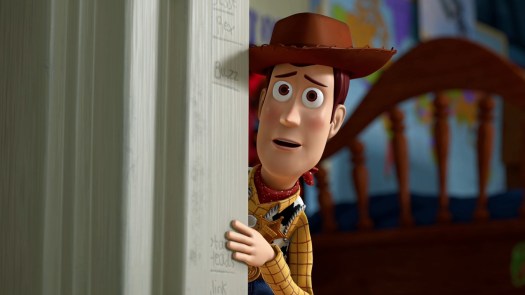
He is also an insecure, cloistered, inflexible, and self-centered protagonist in his worst moments, and I think that is the unsung brilliance of “Toy Story” as a whole.
Part of the genius of Woody’s flaws is how under-stated they are from the outset. We as an audience introduced to Woody from two perspectives- that of Andy, the boy who loves him above all the other toys, and Woody himself. To us, Woody is a simple, sentient toy of simple values- stay close to his owner and keep all the other toys in order. There’s a warmth and a geniality to his character, thanks to this framing and to the charisma given to him by the vocal performance of Tom Hanks, and we’re inclined to love him as much as the cowboy-loving Andy does. His approach to leading the toys during such occasions as Andy’s birthday is portrayed in a sympathetic and relatable light, and it’s telling that we’re given the “no one’s getting replaced” speech from his perspective, since another perspective may reveal the inherent, self-assured smugness of someone who’s been at the top of the pecking order for some time. It’s when Buzz Lightyear enters the picture that we see that Woody has a crippling sense of self-interest, and that Woody could only maintain the facade of a heroic leader so long as threats to his leadership were miles and miles from him. The second Buzz becomes a contestant for Andy’s undivided attention, Woody becomes a veritable green-eyed vulture attempting to return to his comfort zone and keep this supposed intruder out of it.
The worst of it all, of course, being that Buzz himself did nothing wrong.
Lightyear isn’t even concerned with how he’s the favorite, as he is stuck in the programed delusion that he is that “real” Buzz Lightyear and that his is on a mission to save the galaxy. Typical heroes would help Buzz adjust to the existential struggle that inevitably would follow his discovery of being a toy, but it’s not until Woody’s schemes directly endanger Buzz that he starts developing some self-awareness. Even then, he only truly apologizes to Buzz and confesses how great of a toy he is until he’s one morning away from being demolished by the toy-torturing Sid Phillips. Only through a threat of that magnitude is Woody able to realize he was retrieving Buzz for Buzz’s sake, and not for his own, or for Andy’s. The best part of all of this, though, is that he’s still sympathetic in his development, and he’s still got the virtues of loyalty and emotional vulnerability that makes us root for him in spite of his selfishness instead of hating him for the situations he involuntarily instigates. By the second movie, he’s kept that ideal of looking out for his friends, as demonstrated by his daring bid to stop the toys (the squeaky penguin Wheezy in particular) from being sold at a yard sale, but even then, he’s got some growing up to do, since being claimed by a toy collector and meeting the toys made famous by the cancelled hit show “Woody’s Roundup” shows him the previously-ignored risks of sticking with Andy until he grows up. When Buzz and company finally make it to rescue Woody, he’s decided he’d rather be immortalized in a collector’s museum than be with his loved ones and risk the kind of abandonment that Jessie, the claustrophobic cowgirl, suffered as her owner grew. One could argue that Woody was acting out of interest for Jessie, Bullseye and Stinky Pete, but the first movie does show that there’s a bit of the stuffy egotism of Pete inside him, so the impetus behind Woody’s action is not so clear cut.
That thin line between Woody’s virtues and flaws, however, is arguably what makes him one of the most brilliantly written characters in animation, and the truly three-dimensional nature of his character is best exemplified between “Toy Story’s” third and fourth installments. “Toy Story 3”, for instance, shows that he’s grown considerably, and his initial plan to stay in the comfort of Andy’s presence is offset by his clear yearning to be with the other toys in the day care they were donated to. What’s more, he’s directly responsible for the rescue of his friends from that same day care, run by Lotso (Huggin’ Bear), whose dictatorial leadership and all-consuming fear of abandonment could be seen as extreme reflections of Woody’s own micromanaging and superiority complex. Woody simultaneously understood the despair inflicted by being replaced and forgotten by Daisy and the true evil behind his actions toward other toys of his ilk, and Woody’s decision to put himself in that risky position is an unquestionably heroic act for this complicated cowboy. The toys all had their fears and struggles in transitioning to whatever the next chapter was in their lives, and Woody was the one to make it so they had a chapter to turn a page to. Still, going back to the idea of those loose ends in the fourth movie, the writers truly understood the questions left overlooked by the climatic atom bomb that was the third film’s ending, and the makers of the most recent “Toy Story” made sure that the conclusion to Woody’s story had no meat left hanging off that bone.
Woody’s expectations upon being given to Bonnie along with the other toys are basically those of the audience- he and the others are safe with a new owner, and he will get right back where he was when they were with Andy- forgetting the fact that Bonnie is a different child with different interests, and that he isn’t entitled to the favorite spot by virtue of once occupying it. Troubled by this discovery, he essentially resolves to live vicariously through Forky, a toy given sentience when Bonnie created him in kindergarten, and whose longing for the security of trash gets both him and Woody ejected from the van. Forky’s attachment to the trash is one portrayed as suicidal to a degree, but there’s an underlying lack of empathy in Woody’s attempts to keep him out of it. Sure, he has the best of intentions, but starting out, Woody’s protection of Forky is less about giving him a place to be safe and more about finding some place in Bonnie’s development that compensates for his lost position at the top. It’s only until Woody explains his importance to Bonnie by comparing that importance to Forky’s comfort in trash that he is able to break through to him and convince him to be a toy, and that understanding was yet another example of the empathy that Woody was still, even now, still developing.
Still, there’s a core element to Woody’s character that unifies both his sympathetic qualities and his flaws, and that is the struggle to find his purpose independent of the “toy-owner” dynamic. He’s finally able to do so on that journey to get back to Bonnie and the other toys, during which he finds Bo Peep, a porcelain shepherd from the first two movies whose separation from Woody before the third one is finally given full focus. When she reveals she’s been owner-less, “lost”, and on her own track for the last several years, it’s treated as a callous and misguided decision at first, but as Woody comes to see her point of view during the mission to get Forky back to Bonnie, he sees the dilemma of being a “lost toy” from all sorts of perspectives and sacrifices all sorts of things. From giving his voice box to a “Gabby Gabby” doll who previously appeared imposing and creepy due to her desperation to be “whole” and loved to putting Forky’s return to Bonnie above his own, Woody’s character arc reaches a true conclusion in “Toy Story 4”, which makes his ultimate departure from the gang we’ve come to know and love all the more surprising, bittersweet, yet ultimately satisfying and poetic. Woody’s story is, perhaps in one sense, well and truly over with his foray into being a stray “lost toy”, but even if the series decides to continue without him, we as an audience can sense that he is finally comfortable outside the bubble he’s locked himself inside of, especially with the knowledge that he has Bo Peep to love and travel with, and that he’ll always have the memories of (and possibilities of running into) his old friends.
“Toy Story 4” may be a somewhat halfhearted entry in the series in regards to its ensemble cast, and it may undermine some of what was set up in terms of subplots and the development of other characters (Buzz Lightyear in particular), but rather than have that be the final takeaway, I’ll instead confirm why an otherwise unnecessary entry ended up succeeding, and part of why the series is more than just a nostalgic dead horse- Woody is a multi-faceted, flawed, yet endlessly endearing protagonist whose characteristics are exactly what one should build this sort of overarching narrative on. His self-interest and kinder traits never once eclipse each other, and the writers have written the old cowboy doll as one whose actions are thoroughly informed by the makeup of his character.
Still, I’d hate for my own perspective to be the only one on Woody or the “Toy Story” franchise, so I invite any readers of mine to give their own takes on both of these things in the comments below, on Facebook, or on Twitter. I’d love to see what discussions could be bred by this and other “Rich Ruminations” posts.
 Rich Reviews