
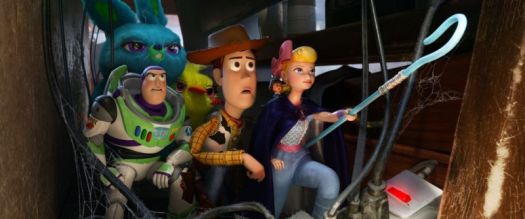
I knew from the outset that I was inevitably going to cover “Toy Story 4” when it was announced and advertised, and not just because I have a childhood history with the franchise. Each and every “Toy Story” film, following the misadventures of sentient toys led by the now-iconic cowboy Woody and space ranger Buzz Lightyear, are animated masterpieces in their own right, as the stories are all well animated, charming, populated by lovable characters, and evocative of the kind of wonder and imagination that goes overlooked in animated film-making these days. In particular, the previous film in the (as of now) tetralogy of movies from Disney/Pixar served as an excellent bookend to the story of the iconic toys come to life, managing to be hilarious, gripping, and emotionally charged in equal measure while giving satisfying answers to the question of the toys’ collective status without their original owner, Andy. To say that a fourth film’s announcement was a divisive subject among fans and critics would be quite the understatement, but unlike most of the internet and film community at large, I was more intrigued than outright dreading the prospect. After all, “Toy Story 3” was once held in caution by those who loved the first two movies before it became many a fan’s favorite in the series, and the idea for a fourth film, in which previously-absent side character Bo Peep returns to reunite with Woody, was pitched long before the trailers aired. Also, I’m kind of sick of the reactionary impulse often reserved for trailers, as there’s only so much a person can gleam from a trailer for a franchise installment consisting of a few minutes at most. Given all of this, my preemptive curiosity was less centered on “will this series top itself?” then “how will this series top itself?”.
The answer to that turned out to be “on several fronts.”. “Toy Story 4” is a movie aware of the blink-and-you’ll-miss-them loose ends left untied by the end of “Toy Story 3”, and the ways in which it sets out to put the knots in place results in an emotional maelstrom of laughs, tears, and character closure that anyone even passively interested in the series should see.
Following “Toy Story 3’s” conclusion, in which Andy’s toys moved over to a newer, younger owner in Bonnie, the gang has found happiness once again and things are as they were back in their old home. Things are far from perfect for everyone, however, as Woody (Tom Hanks), used to being a favorite toy, is played with less and less by Bonnie, and Bonnie herself is terrified at the prospect of going to Kindergarten. Fortunately, she finds comfort during arts and crafts, making a spork toy she names “Forky”, and the DIY plaything quickly becomes her favorite. Unfortunately, a family road trip becomes complicated when the spork gains sentience (and the voice of Tony Hale), and both he and Woody are ejected from the RV while the cowboy attempts to save the new favorite from his own existential doubts. While trying to return to the RV, Woody and Forky discover multiple toys in an antique shop, all of whom are trapped in their own minds thanks to their troubled experiences with being either lost or separated from past owners, with Woody’s old flame Bo Peep (Annie Potts) now among them. With old friends and complicated feelings returning (all with little time to catch up to Bonnie’s family), Woody must save his friends, both new and old, return Forky to Bonnie, and decide where his loyalties will take him, all while Buzz (Tim Allen) attempts to ensure Woody’s rescue mission is successful.
Before my spolier-cautious examination of the movie’s narrative successes, I think it’d be best to talk about “Toy Story 4” on the technical side of things. For one thing, it’s utterly astounding how well this series has done in terms of updating its visuals. For a start, I’m impressed with how the integrity of the main characters’ designs have not been negatively impacted by the increased realism of the animation. Speaking of which, that animation is glorious. Whenever the toy characters are alone on screen without any of the humans, the environments and objects look borderline live-action, and I’m especially wowed by the series’ gradual mastery of plastic visual textures. Little things like the stuffing inside plush toys look remarkably real, but what really makes it all work from a visual standpoint is the balance it makes. The characters are still allowed to be fluid and cartoony as they always were in spite of obvious updates, and that kind of dedication (previously demonstrated in all of Brad Bird’s movies) is commendable, especially for a sequel. In addition, something that will probably go under-appreciated about this film is its score. The tunes and leitmotifs by Randy Newman were always catchy, whimsical and effective, but deserve special mention here for how they are all applied to fit the more intimate, heavy story beats throughout the film, especially towards the end. Still, the strengths of the movie really do lie in that narrative, and transitioning to that end, the voice acting is as impeccable as always. Tom Hanks has had years of experience with Woody’s character under his belt, and that understanding is thoroughly translated through his performance here. In him, we hear the same good-hearted, brave, yet troubled leading man that we’ve come to love since day one, and both his tenderness and his inner turmoil is worn on Hanks’ sleeves, or in this case, his voice. Tim Allen is also still great as Buzz, and helms some of the funnier moments in this movie. In my opinion, however, the highlight vocal performance is unambiguously that of Annie Potts as Bo Peep. The character herself has taken on a braver, more adventurous front since her absence from the series, but it never feels forced or cliched due to how believably Potts plays Bo’s development into that niche. Special mention should also go to Tony Hale’s Forky, for injecting endless charm into a more comedic character who could have been fairly annoying otherwise.
All of this is in service to a story that expands on the thematic aspirations of the other “Toy Story” films in wondrous ways. While it’s true that “Toy Story 3” did wrap up the series in a lot of respects, in that it reached the peak of testing the bonds between the characters and how much the stakes can be raised, those aforementioned loose ends still left just enough room for a sequel. “Toy Story 4” is aware of that space, and thus crafts a more intimate narrative focusing on the major characters and their ideas of what a toy truly is. Without spoiling too much, both Forky’s introduction and Woody’s inner turmoils about where the story has taken him both serve as interesting, multi-layered explanations of that question, and how they play out makes for one of the most bold and commendable climaxes in an individual franchise film. Also, the nature of this film’s narrative focus means there are no true villains, even when menacing ones are introduced, which is equally impressive for a mainstream animated film. The side characters (save for new introductions) are downplayed significantly in terms of screen time, but for a film with “Toy Story 4’s” goals, that’s an arguably necessary approach, and that minor sticking point should never take away from what an effective character study this is for its main players. “Toy Story” and its characters encompass a world that has grown up with its audience and their families, and that it’s consistently succeeded in this over the course of four movies is nothing short of an achievement.
So please, see “Toy Story 4”, and its predecessors, if you haven’t already. “Toy Story” is as much a journey as it is a megabucks flagship franchise from Pixar.
 Rich Reviews