
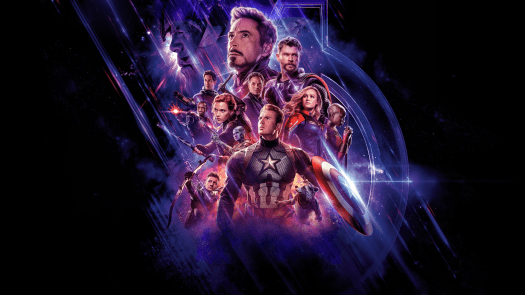
Looking back on some of the films I reviewed, specifically those trying to capture the comet’s tail that was the success of the “Marvel Cinematic Universe”, I can’t help but feel like cinema-goers everywhere have forgotten how much of a feat the franchise’s success truly is. A gigantic series of multi-generational, interconnected films centered on multiple superheroes that occupy vastly different genres and tones had every reason to fail, and every attempt following the “MCU” format has been shaky at best and groan-worthy at worst. I might have said before that the best of these films are the ones that can stand the strongest on their own without the aid of the larger continuity, but while I still stand firmly by that sentiment, part of the reason I did stand by it is because of the seemingly futile buildup that went into both today’s subject and its predecessor, “Avengers: Infinity War”.
“There’s no way the appearance of Thanos could be half as interesting as those post-credits scenes make him out to be!”, thought I, before “Infinity War” blew my mind by presenting a multi-layered tragedy, a veritable superhero epic, and a prime example of paying off a narrative setup.
One of my greatest regrets is not reviewing “Infinity War” when it was the hottest ticket in theaters, since saying that it surpassed all expectations would be an understatement. That film gave us a story of iconic heroes of the Avengers and beyond at arguably their lowest point, in which cosmic stakes are at play and a villain from beyond the stars comes forth to see to the conclusion of his plans for universal restructuring, all while climbing his way to the top of numerous lists for “greatest movie villains”. In short, that film was an event, and one that paradoxically worked due to the strength of continuity and the almost subconscious investment the film-going public has in the greater “MCU”. Superheroes have often been touted as the “Greek myths” of American pop culture over the last few generations, and the strength of the “Marvel Cinematic Universe” has lied in its ability to examine and re-contextualize their iconic characters over the course of an overarching narrative spanning multiple parts. The Marvel films, in this way, are a collective superhero soap opera in the best of ways, and like “Infinity War” before it, “Avengers: Endgame” seeks to complete the payoff for years of buildup to numerous plot points: to the Infinity Stones, to Thanos, but most of all, to a particular era of the Marvel film franchise.
Also much like “Infinity War”, “Endgame” succeeds on pretty much every front, and I’m going to do everything in my power to recommend this movie without hitting plot points too hard.
Following the events of the Avengers’ struggle with Thanos, in which half of all life was erased from the universe by the Infinity Stones, the remaining heroes of the Marvel canon have all but embraced the despair of loss and the fall of superheroes. Even with the immediate threat absent from Earth, the Avengers and their associates have all but disbanded and retired with a few exceptions. Hope seems to return, however, when a previously-absent hero returns from a previously unexplained absence, and discovers that the source of that absence may be the key to reversing Thanos’s universe-shattering snap. Few are willing to take the risk, least of all Tony Stark (Robert Downey Jr.), Steve Rogers (Chris Evans), or Thor (Chris Hemsworth), all of whom are mourning in their own ways, but soon it becomes apparent that a choice must be made between the world left behind by Thanos or the one that might be saved by venturing into the unknown. Whatever the choice, one thing is clear: the end of an era is nigh.
Truthfully, the synopsis may have been the toughest part of that review (among many tough parts), and while I’m aware I’m being quite vague with the details, it’s only because I consider “Avengers: Endgame” a mandatory viewing experience alongside “Infinity War”. That does come with a rather noticeable caveat, in that “Endgame” works better as a followup to its mind-blowing predecessor, but that should not take away from the strengths of the film by any means. The performances, for one thing, are as fantastic as one could imagine from a cast of actors that have years of experience with these characters under their belt. Highlights are near impossible to pin down among the main players and the side characters, and to do so comprehensively would give too much away, but something that struck me as particularly mind-blowing was Robert Downey Jr. as Stark. We’ve all come to know Downey as the cynical, snarky, and unfailingly logical man behind Iron Man, but something that has gone under-examined up to this point is the actor’s almost instinctual ability to sell Stark’s methods of coping with desperation and his personal demons. Again, the particulars cannot be mentioned, but Downey does especially remarkable work as Tony Stark when he’s been backed into a proverbial corner by the accumulating risks brought on by Thanos and his campaign. Speaking of Thanos, Josh Brolin continues to astound me as the villain, and the last two “Avengers” films have been especially remarkable, between the acting and the writing, at giving dimension and nuance to what seems like a generic universal conqueror at first.
Additionally, the film’s visual and cinematic elements are spellbinding in how they manage to engage in spite of its noticeable length. Tonally and visually, “Endgame” is a comprehensive love letter to the “MCU’s” legacy up to this point, and how that is woven into the cinematography and editing must be seen to be believed. Chances are, watching this means you’ve had some sort of investment in at least one of the films preceding it, and after watching “Endgame”, you won’t soon be watching those films the same way again. Still, if there’s one thing I want to avoid being vague about, it’s the film’s ultimate strength: its pathos and mastery of catharsis. A dramatic, climactic film of this nature would be meaningless and empty without proper buildup and care put into it, and “Batman v. Superman” is one of my favorite cinematic punching bags for its lack of understanding of patience and buildup. “Endgame”, however, delivers by virtue of having so much going into it. Say what you will about the greater corporate intentions behind a massive cinematic universe of this nature, but with a few exceptions, one cannot accuse many movies under the “Marvel Cinematic Universe” brand of lacking passion, care or effort. This film, more than anything else, is every bit of that passion, care and effort translated into cinema, and simply calling it a calculated, contractual effort would be reductive logic at the expense of a truly well-crafted movie.
In other words, I cannot say it enough: go see “Avengers: Endgame”. See “Infinity War” before it if need be, but see “Avengers Endgame”. Both it and its predecessor are proof that magic and wonder still exist in the world of film, however thinly spread out it may be.
 Rich Reviews