
Boy, is it good to be back.
Oh, and Happy Mother’s Day, readers!
This list has been a long time coming, and I’ve got numerous regrets about how long it’s taken me to put it out. There are several reasons for this, not the least of which was my ever-mounting obligations and current work schedule, but last year’s excuse was simply being unable to properly compile a list of mother characters in order of ascending significance. After all, there are countless stories about motherhood in the medium of film, from animated adventures and family films to more conventional Hollywood dramas to even action and thriller movies. Another reason for my trepidation behind this list was its framing as a tribute. As with the last parental-themed list, I’ll be dedicating this to my own mother, since she’s given me more than enough to think about in terms of choosing the most loving, protective, and most significant mother characters in the history of motion pictures. With that said, I’ll give my usual disclaimer and say that this list is based on movies that I’ve seen, and I actively encourage discussion and suggestions of those moms I might have missed. Like with last year’s “Movie Dad” list, both biological and adoptive mothers are eligible to be entries, and also like last year’s “dad” list, there is potential for spoilers regarding the plots involving these characters. That said, here is my own personal take on the “Top 10 Moms in Movies”.
10. Mrs. Brisby (The Secret of NIMH)
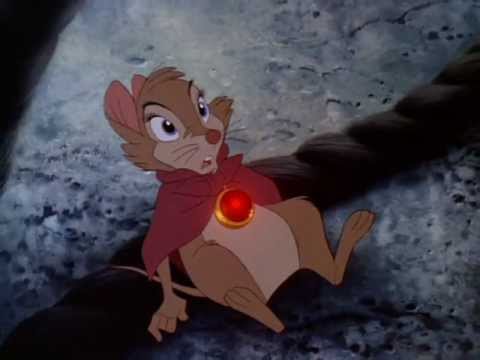
Painful as it is to put this character so low on the list, Mrs. Brisby of the Don Bluth magnum opus The Secret of NIMH loses a few “mom” points for her interactions with the Brisby children being somewhat finite in terms of screen time. That is literally the only mark against this heroic widow, though. Even in the midst of discovering her husband’s role in the founding of a city of hyper-intelligent rats and facing down numerous dangers that even the bravest of these rats find daunting, Mrs. Brisby will stop at nothing to provide for the most sickly of her children and ensure their continued safety against predators, the elements, and the scientists of NIMH. What makes Mrs. Brisby all the more worthwhile is just how much is stacked against her. She’s an admittedly meek housewife, and anything but a seasoned heroine, but still actively risks her own life on her journey, and shows remarkable resourcefulness through it all. Scenes like that towards the end, in which Mrs. Brisby unflinchingly attempts to pull her sinking house from the mud, will stick with me forever, and for the love and determination she demonstrates toward her family, she’s more than earned her spot at #10.
9. Dolores Claiborne (Dolores Claiborne)
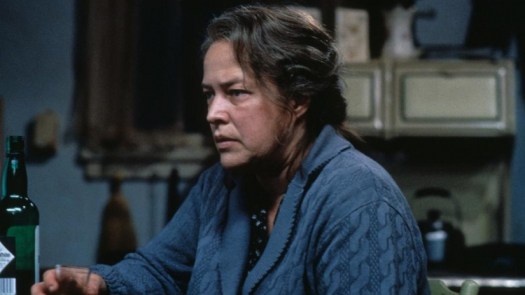
That this film didn’t get as much attention as other adaptations of Stephen King stories is a very tragic scene to me, because Dolores Claiborne, such as it’s presented here, is one of the most raw, intense, and remarkably human stories of familial dysfunction associated with King. At once a tense thriller story of murder accusations and a drama about familial estrangement and feminine strength, the movie focuses on the title character, a housekeeper accused of killing both her employer in her mansion. Things get even more complicated as her estranged, depressed journalist daughter enters the picture, and she suspects her mother of killing her father in the past. I won’t go further with the plot, since I want more people to see this movie, but the revelations build and build as the story progresses, all of them standing as instances of maternal love and strength in their own way. Kathy Bates is running an acting triathlon in this movie, delivering a transcendent performance with a mix of tenderness, blunt honesty, and determination. Add that to the story’s themes, and you have a film that’s a difficult, yet rewarding take on family reconciliation, of which Ms. Claiborne is a captivating star.
8. Kate McCallister (Home Alone)
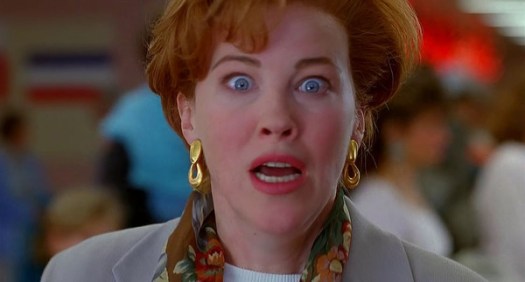
One could hardly accuse this mother of being a perfect one (especially seeing as how she repeated her mistakes in the sequel), but the McCallister matriarch makes this list for being a fairly spot-on portrayal of the pressures of raising a huge family (cartoony presesntation notwithstanding). She may be directly responsible for Kevin being left alone while the family rushed to the Christmas vacation, but the film shows just how much she has to deal with, and she spends the rest of the movie going to any lengths to return to her son. Catherine O’Hara does a great job as this overwhelmed mother, and in spite of the numerous flaws the character has as a mother (not the least of which are her harshness towards Kevin starting out), her performance never ceases to make me cheer for her measures in returning home, and never stops me from bawling like a baby towards the film’s heart-melting conclusion. “What kind of mother” is she? Far from the best, but still one worth putting on the list for her redemption.
7. Maria Von Trapp (The Sound of Music)

This stepmother and music enthusiast probably would have landed MUCH higher on the list had the list not been a personal and analytical one in equal measure (and had I seen The Sound of Music a bit more recently than my childhood). Still, while I was firm on my rule of basing the mom list entries on personal evaluation and attachments, it’d also be intellectually dishonest to give no mention to Maria Von Trapp from the iconic Rodgers and Hammerstein musical. The free-spirited young postulant-turned-stepmother to the seven children of a retired naval officer sang her way into the hearts of both the children and movie enthusiasts everywhere, and her achievements as a mother in film are immeasurable considering both the family she entered and the times in which she came into their lives. From introducing the strictly-raised children to the joys of music and love to aiding the family’s escape from the Nazi occupation of Austria, Maria went above and beyond the call of duty, and all for a family that was at first put off by her seemingly infinite optimism. One could hardly accuse her of being the deepest character on the list, but the performance and stellar singing voice of Julie Andrews makes her impossible not to love, and the timeless songs Maria belts throughout the movie makes for an enduring icon of both musical film and movie motherhood.
6. Every Sandra Bullock Mom (The Blind Side, Bird Box, etc.)

Last year, in the Father’s Day list, I gave special, blanket praise to Steve Martin as an actor who perfectly sold parental characterization across multiple roles. There are numerous candidates for such a representative of mothers in film, but in the end, I chose Sandra Bullock’s mother characters for being compelling, heartwarming leads in spite of having often imperfect material to work with. A few months ago, when I reviewed Bird Box, I listed her among the best of the movie’s strengths, and her performance was made such a strength through her development into the role of a mother and her underlying tenderness beneath the stern demeanor. Keep in mind, Bird Box was a flawed film, as was the sports drama The Blind Side, but Bullock also worked wonders as a mom in that film, too. Cast her as a mother, and Sandra Bullock will warm your heart and stand firm in equal measure, and for giving power to characters in mixed bag movies, she deserves special mention for those multiple mother roles.
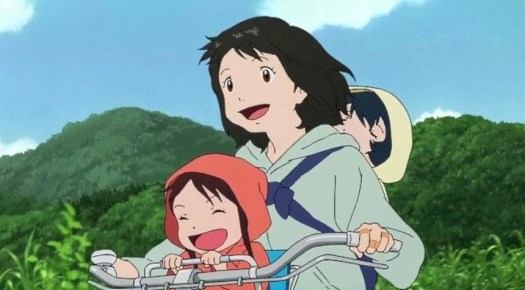
5. Hana (Wolf Children)
I’m going to need a good cry after discussing this entry on the list…
That Mamoru Hasoda hasn’t receive Miyazaki-level recognition for his animated filmography is a crime on the part of the Western film world. After all, his films strike a previously inconceivable chord with audiences in spite of their often surreal atmospheres, and for me, the pinnacle of pathos throughout his vast library of films over the last several years has been 2012’s Wolf Children. Its story is one right out of a fairy tale: Hana is a university student who meets an falls with a handsome, quiet man, and the two continue their romance in spite of the discovery that he is, in fact, a werewolf. The two have children and aspire to happily raise a family together, but the father is lost to an accident while hunting, leaving Hana to raise a son and daughter alone. What makes her struggles and determination so endearing here is that her children are both human and animal in equal measure: her children change from kid to wolf with the flip of their emotions, and keeping both them and the house together means that Hana must work herself to the bone. Still, the movie leaves no room for doubt that Hana did her job well, and even though she can’t have all the answers when her children start questioning their natures as either people or wolves, she nonetheless does everything to make sure her children are both happy and safe, and succeeds by the very end in spite of some expected heartbreak. Hana’s all-encompassing love for her children, along with her struggles as a single parent and some spot-on dub voice work from Colleen Clinkenbeard, makes her an imperative mention on this list, and a perfect character to view on Mother’ Day.
4. Nakku Harriet (Queen of Katwe)

Back in my days as a critic for the La Salle Collegian, I reviewed a fairly low-key, Disney-produced sports drama about chess, called Queen of Katwe. I liked it, but was kept from loving it thanks to taking some “Hollywood” turns. Still, if there’s one thing that almost made me love this movie, it was Lupita Nyong’o’s performance as Phiona Mutesi’s mother. The story (fairly accurately based on a true account from an ESPN magazine article), is a fairly typical one of balancing glory with familial dedication, in which Phiona finds success and relative fame in chess tournaments and is met with some opposition by an over-protective mother, but unlike with most stories of this nature, Harriet is not portrayed as antagonistic. She, in fact, has numerous reasons for being skeptical about Phiona’s ambitions of making it in the chess world, not the least of which are her struggles raising her and three other children in the titular Katwe slums in Uganda. Her skepticism is born from a mix of fear, parental concern, and acknowledgement of the possibility of losing Phiona, which makes her later support of her daughter’s wish to escape their harsh life all the more surprising and heartwarming. A lot of Nyong’o’s performance relies on silently communicating both cautious concern and maternal warmth, and her acting seems like she’s actively channeling the struggles of a mother in such a bleak situation. You’ll be happy to know that her love was not lost on her daughter’s ears, as she went out of her way to ensure her family knew the same kind of security and happiness once she hit it big in the chess world. I mean, I sure was happy by the film’s end. Harriet, you deserved that happy ending for being the mother you were.
3. Helen Parr/Elastigirl/Mrs. Incredible (The Incredibles)
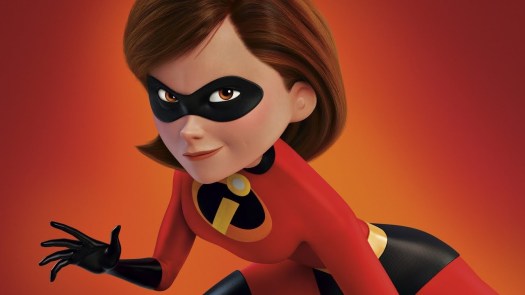
Speaking of Disney, here’s yet another animated entry on the list. Much like Hana after her, Helen Parr deserves some special mention for successfully raising a family under harrowing, supernatural circumstances, albeit with super-powered humans being involved instead of werewolves. Sure, “Elastigirl” might have had some help with her husband around (especially in the sequel, after coming to terms with his midlife crisis), but the first film’s second half was essentially her story, about how she came to terms with the world’s need for super heroes and both her and her family’s need to come to terms with their identities as “supers” in a world that doesn’t quite know how to deal with them. In other words, she had everything against her and then some, and yet she still handles it all with the same barbed wit and determination she had back in her heroic heyday. In spite of her determination to distance herself from the past, she slipped back into the mask and spandex seamlessly, all while raising her three children with equal effortlessness. Flawed as the sequel may be, this franchise nailed the family dynamic, and having acknowledged the accomplishments of Mr. Incredible in the Father’s Day list, it felt only natural to give even more praise to Mrs. Incredible, the woman who basically held the family together.
2. Sarah Connor (The Terminator series)

Talk about carrying the weight of the world on your shoulders…
Aside from maybe the final entry on this list, Sarah Connor of the Terminator movies probably went through the most hell of any character in pop culture. After all, the young college student probably didn’t expect the worst out of life, let alone to be pursued by a cybernetic killer or to give birth to the eventual savior of humanity. Her struggles are especially palpable by the end of the first movie, in which she barely manages to finish off the titular Terminator, and at the start of the second, during which she’s institutionalized and kept from her only son for her (understandable) mental breakdowns brought about by the revelations. Ms. Connor had every reason to stay locked up and embrace the end, but once the option to protect her son became a viable one…
Boy, did she ever deliver. The antagonist of the movie, the T-1000, could shape-shift, kill efficiently, and brace bullet wounds like paper cuts, yet Sarah willingly and aggressively stood her ground and stood by her son John like she was always there. The quality drop over the course of the series did her few favors, but I doubt anyone will soon forget her evolution from damsel to danger. Heaven help you when you’re against a mom, robots and aliens everywhere. And speaking of the latter…
1. Ellen Ripley (The Alien franchise)
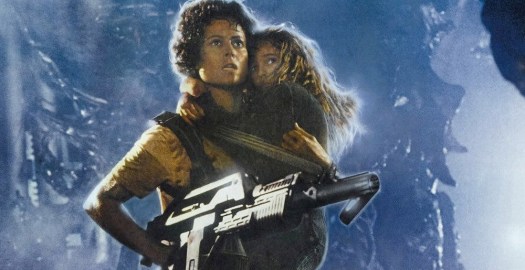
As I stated before, both biological and adoptive mothers are more than fair game for this particular list, and the number one slot goes to a character who clarifies as both. One could make the argument that Ellen Ripley’s maternal side wasn’t demonstrated until the second movie (and later into it, at that), but there’s more than the plot of Aliens accounting for her placement this high on the list. First of all, she is, in fact, a mother to a biological daughter, and one that she vocally expresses regret for being away from in the first movie. In fact, the length of time that separation went on for becomes especially apparent by the second movie, in which it’s revealed her daughter is dead and she’s entering and age she wasn’t prepared for. Second of these factors is that second film. It’s amazingly how quick she makes the switch from battle-hardened cynic to maternal substitute once Newt enters the story: Ripley expresses either disdain or ambivalence towards nearly every other character starting out, but she immediately jumps to protecting and comforting the orphaned colony child. Moreover, she has little concerns once she’s in “mom” mode. Ripley isn’t just Newt’s “mama” by association, she’s “mama bear“, staring down even the queen Xenomorph alien like she’s nothing but a glorified bug, all because the girl was in danger.
Most of all, though? Ellen Ripley is a mother to all of us, as purveyors of popular culture. Intentionally or not, Sigourney Weaver and James Cameron created the strong woman who would go to stand as a symbol of protectiveness and perseverance in the greater history of films (specifically, in the realms of horror and sci-fi), and she makes the top of the list for significance and long-standing power more than anything else.
Oh, and for reminding me of all the things that I love about my own mom- strength, persistence, and above all, protectiveness.
That said, I hope you all enjoyed the list, and encourage both responses and personal entries. Stay tuned for more in the near future.

 Rich Reviews