
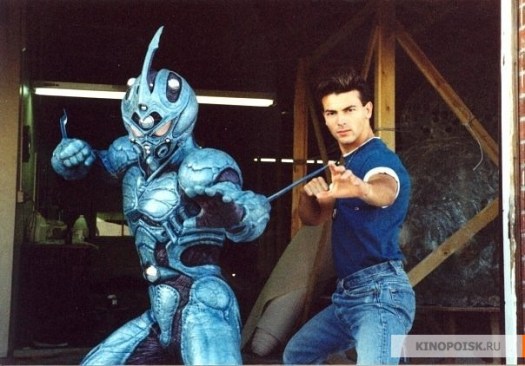
Last time on Ani-March, I took a look at one of the lower-rung Hollywood films based on an anime/manga franchise, “The Guyver”. In spite of being a rather low-budget effort with a finite lifespan in theaters, the movie saw to some moderate success on home video, and thus saw to enough revenue to birth a direct-to-video sequel. I’d imagine expectations of audiences going into this one couldn’t possibly be lower, given the circumstances: the first “Guyver” movie is technically impressive in some places, but the glossy monster costumes are in service to a cheesy, unfocused mess with tonal problems bred from a complete lack of faith or investment to the source material. That’s not to say change is inherently negative when it comes to adaptations, but the “Power Rangers” brand of action-comedy should not have been meshed with the dark horror elements of the original franchise. So, how did “Guyver: Dark Hero” fare with an even lower budget and a different creative team than the original film?
Somehow, against all odds, it turned out to be the best American anime film adaptation to date. By dropping most connections to the first film and pursuing a completely separate tone, look, and feel, “Guyver: Dark Hero” manages to be both a truly remarkable sequel and a fun popcorn action film taken on its own. Though this film, admittedly, might be a hard sell to anyone outside of hardcore fans of the genre, I hope I can do well to convince you of this film’s success, especially compared to its predecessor.
Set a year after the events of the first “Guyver” film, “Guyver: Dark Hero” continues following the exploits of Sean Barker (this time played by David Hayter), who now roams the street using the Guyver’s powers to fight crime. He’s driven to isolate himself and look into removing the device after he discovers its murderous tendencies. In his travels, he discovers an archaeological dig site in Utah assigned to a crashed Zoanoid ship, and aids the researchers in their pursuits, thinking he might find some answers about the Guyver. Things take a turn for the harrowing, however, when the Chronos corporation closes in on Sean and the researchers, and to make matters worse, previously undiscovered Zoanoids have taken to pursuing Sean along with his old enemies. With little choice but to fight back, Sean continues in his struggles against Chronos, the new aliens, and the violent impulses brought on by the power he still has yet to truly grasp.
As stated before the synopsis, this sequel takes a much darker tone and goes out of its way to establish several noticeable differences from the first film, the most obvious being its rating. The first “Guyver” film was marred by its desire to have a broad audience, with goofy slapstick action being constantly shoehorned into effects, heavy, darkly shot scenes resulting in a middling “PG-13”. “Dark Hero”, on the other hand, boasts a hard “R” rating, and that shows almost immediately. Still, unlike most R-rated sequels, the darker tone doesn’t come off as too heavy-handed, and the admittedly swear-heavy script keeps its in enough moderation to not be seen as forced. Also in service of the mature tone are the action scenes, which, keeping more in the spirit of the anime and manga, is much gorier and well-choreographed. Characters receive bloody wounds, aliens have limbs ripped off, and the Guyver’s preferred method of execution here is decapitation via the suit’s previously ignored elbow blades. Previous reviews compared such action to an “R-rated ‘Power Rangers'”, and that is an apt description of the film’s unique style. What also makes the fights work so well is their integration. There are fewer fight scenes than before, but they’re considerably longer, and the addition of fight scenes in daylight, rather than simply in the dark, adds some much-needed variety that the fights in the first film were utterly starved for. Even the cut budget didn’t hurt the effects too badly, since the fight scenes actually managed to include the Guyver’s once-underutilized powers to great effect.
The improvements don’t just begin and end with the technical and cinematic elements, though. The acting across the board, while still a little hokey, manages to be a much more dramatic effort on the part of the actors, and minus a few extras, the cast does a fairly good job. What’s especially praise-worthy is David Hayter as the new Sean Barker, who would later come to voice Solid Snake from the “Metal Gear” video game franchise. In those games, Hayter made a name for himself by nailing the grisly, yet conflicted elements of Snake’s character, and i wouldn’t be surprised if “Dark Hero” gave him some experience on that front. He not only exudes much more natural charisma and strength than the unremarkable Armstrong, but also manages to sell the dramatic scenes in what’s otherwise a fairly cheesy movie in places. Hayter would later state in interviews that he loved working on this film and would readily come back to future “Guyver’s”, and it really shows in his performance here. As an added bonus, Hayter even did some of his own stunts whenever Sean is out of the suit, which makes both his performance and the action scenes all the better. What really makes me respect “Guyver: Dark Hero” so much, however, is its commitment to its established tone. While the film’s dark tone never truly allows it to escape the cheesiness brought on by its budget and its predecessor, it makes up for its own limitations by attempting a loving send-up of the ultra-violent anime genre that the “Guyver” franchise occupies. If the rubber suits as low resolution were any clue, this movie is far from perfect, since the cracks in the metaphorical sculpture are as visible as they are. Still, unlike the worst of the American anime-based films, “Guyver: Dark Hero” is unafraid of what it truly is, and does surprisingly well as an adaptation while capturing everything fans tend to love about anime like “Bio-Booster Armor Guyver”.
In short, “Guyver: Dark Hero” may certainly be a niche film, but stands as one of the best successful of its kind. More on the latest story in anime adaptations next review.
 Rich Reviews