
If there’s something I wish I could talk about more in terms of film-related topics, it would definitely be B-movies. There’s a masochistic sort of joy to be had in experiencing the bad ones, and the good films that just so happen to have a lower budget tend to be pleasant surprises that you didn’t know you needed until you had them. Even the bad low-budget movies have something to enjoy, be it the execution of a cheesy effect or a line read so bizarre one would think an alien was cast in the role of the character spouting it. Ani-March is going to cover both ends of the B-list, direct-to-video spectrum, since two such sci-fi B-movies just so happen to be based on a fairly popular manga and anime franchise. First on this duology is 1991’s “The Guyver”, loosely adapted from the manga “Bio-Booster Armor Guyver”. The story of a Japanese teenager fighting hostile aliens with an uncovered suit of extraterrestrial armor has fallen somewhat into obscurity over the years, but during its debut run in America during the late 80’s and early 90’s, the manga was one of the most popular imports of the decade, and so New Line Cinema released its own film adaptation in 1991. The film was produced on a low budget (around 3 million) and was released to mixed reviews, coming under particular scrutiny for its false marketing of Mark Hamill as the titular hero. Hamill, in fact, is only a supporting character (as you’ll soon see), and film analysts were correct to call the Hamill-centric marketing out as nothing more than a popularity stunt. Still, unlike with “Dragon Ball” or even “Ghost in the Shell”, “Bio-Booster Armor Guyver” is exactly the kind of anime IP that lends itself to an American adaptation, since the characters themselves were less stylized and iconic, and the story was framed with the impetus that the Guyver could fall into any hands, Japanese or otherwise. So, how does this film fair? Well, I’ll open this look at the movie’s many problems by saying it’s a bad look when the direct-to-video sequel was five times better. With that, the story:
The story of “The Guyver” begins shortly after the murder of Dr. Tetsu Segawa, a technological researcher for the enigmatic Chronos Corporation. CIA agent Max Reed (Mark Hamill) soon discovers that Segawa had stolen an advanced suit of alien armor, known as the Guyver unit, and that the doctor was keeping it from Chronos’s CEO, who is, in truth, the leader of a unit of alien invaders known as “Zoanoids”. This discovery leads Reed to coming to the aid of the sole living relative of Segawa, his daughter Mizuki (Vivian Wu), who herself is dating amateur martial artist Sean Barker (Jack Armstrong). During Reed’s investigation, Sean obtains the Guyver from evidence after trailing both him and Mizuki to the crime scene, and after a tussle with some thugs, discovers that the device grants him strength-inducing armor and alien weaponry. That Sean happened upon the Guyver is both a blessing and a curse, for while lackeys of the Zoanoids and Chronos are tripping over themselves to kill Sean for the armor, it may very well be the only thing capable of stopping their plans for world domination and protecting his love from the ever-encroaching alien threats.
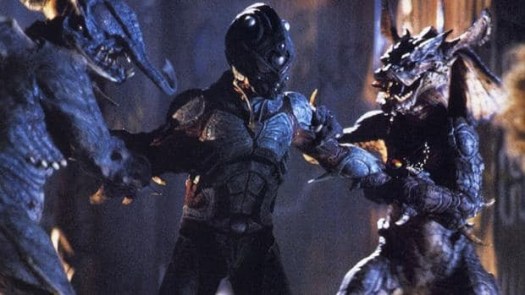
Both that synopsis and the earlier-mentioned budget should be a clue for the type of B-movie tone one should expect from “The Guyver”, but what’s baffling about this movie’s tone is that it never truly seems to stick to one direction. The low lighting, almost omnipresent nighttime scenes, and intentionally horrific creature designs seem to be working in the interest of a dark, gritty story like that of the manga and subsequent anime, only for the goofy synth music, corny dialogue and slapstick action scenes to completely shoot that tone in the head and force the movie into a hard left turn towards dumb comedy. This kind of awkward tonal balance bears no small resemblance to the 1990 “Teenage Mutant Ninja Turtles” film (also produced by New Line Cinema), but whereas the comedy in that film was actually funny and served to offset the dangerous atmosphere of that film’s New York City, “The Guyver’s” absolute refusal to space out scenes of those conflicting tones or have well-written dialogue spoken by likable characters makes the film fall completely flat on its face when it tries to thrill or amuse. Speaking of characters, I find it utterly baffling that they so heavily promoted Mark Hamill as the star of the movie, since his character exists to be utterly useless outside of introducing the plot. Never once does this CIA agent even truly use the gun he totes around from scene to scene, and his lack of agency becomes painfully obvious in the second half, which outright confirms that the promotions only wanted his name up there to draw in audiences. Still, I don’t necessarily blame them for their choice in marketing, as the actual star, Jack Armstrong, has all the unbridled charisma of a piece of pocket lint. When he isn’t awkwardly cold reading his way from scene to scene, his character is getting his head handed to him until he gets his hands on the Guyver, after which he invariably wins through his new superpowers. Protagonists like Sean Barker, with no stated strengths outside of plot-granted powers, are utterly uninteresting and infuriating to me, and it’s all the worse here due to Jack Armstrong’s wooden performance and the character’s bad dialogue. On the subject of the acting, the performances across the cast range from wooden and sleepy (as with Mark Hamill and Vivian Wu) to hilariously hammy at best, and grating at worst. On one hand, it’s fun seeing British character actor David Gale ham it up as the Chronos leader, during which he delivers monologues like a fusion of Christopher Walken and Willem Dafoe. On the other hand, the other villains are cringe-worthy, and the worst offender in this regard is “Good Times” actor Jimmie Walker, whose dialogue consists almost exclusively of rapping, and whose only positive is that his role is relatively small in this film. I will grant “The Guyver” this, though- its alien and costume designs are gorgeously constructed, and it kind of makes me miss the days of rubber suits and practical effects for creatures like the ones in this movie. I wouldn’t be surprised if those costumes dealt a blow to the film’s budget, though, since the Guyver suit’s flashier powers are never incorporated into this movie until the very end. It’s a shame, too, because the first “Guyver” movie could have been a lot of fun if it had a tighter budget and a greater sense of focus outside of trying to be a more horror-twinged “Ninja Turtles” or “Power Rangers”.
As is, “The Guyver” is a sloppy, campy, unfocused and agonizing mess of a movie that only benefits from having somehow birthed a much better direct-to-video followup. More on that in the next Ani-March review.
 Rich Reviews