
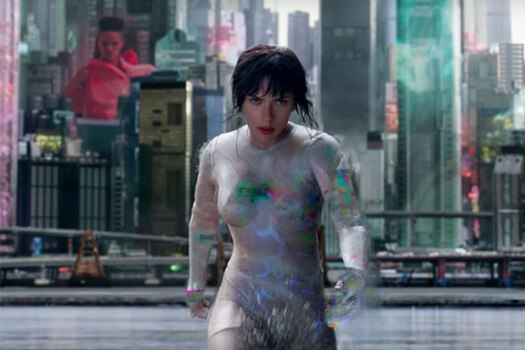
The 2017 American adaptation of the beloved, historically significant cyberpunk anime film “Ghost in the Shell” was always going to be a tough film to cover for many reasons, not the least of which is the controversy surrounding its casting. Upon the announcement that Scarlett Johansson was to star in the movie as Motoko Kusanagi (aka The Major), fans and critics were reasonably incensed at the film’s whitewashing of the film’s protagonist. There’s a lot to unpack about the casting decision itself, and while much has been said before and since the film’s release about the tone-deaf nature of the casting, what’s most egregious to me about the decision was how Scarlett Johansson’s presence in the movie was reflective of a more comprehensive problem with the remake: a lack of true attachment to the source material. This is an especially contentious issue given the insurmountable significance of the original film and anime franchise- “Ghost in the Shell” isn’t just important in the history of anime, but for the broader film landscape as well. Films of similar significance, such as “The Matrix”, were inspired by Masamune Shirow’s vision of a cybernetically driven future Japan, and the Mamoru Oshii film that arguably began the anime’s rise to fame is rightfully held in high regard for its groundbreaking animation, direction, and observations on what constitutes sentient life. Additionally, the original film’s world was one that took a de-constructive examination of Japan’s government and relationship with technology, so a remake in which the setting was shifted to something more conventionally American would be a difficult thing to write at best and a display of disrespect for the original at worst. That’s not to say a more Western interpretation of this story couldn‘t work, but the film’s trailers and marketing were insistent on displaying remakes of iconic scenes from the animated film, meaning the film’s setting felt right away like it was torn between the visuals made for one kind of movie and the world building meant for another. The film couldn’t simultaneously be a faithful remake and a reinterpretation, and those clashing elements are exactly what led to the kind of production troubles that hit this movie. It’s a sad state of affairs, too, that I had to talk about the deeper flaws during production at this length, because those flaws, truthfully, are the most interesting things about this bland, paint-by-numbers cyberpunk slog.
“Ghost in the Shell”, much like its source material, is set in a distant future city dubbed “Section 9”, in which cybernetic body enhancements and replacements are the norm. The film’s title refers to the human brains and their relationships with the cyborg bodies being massed produced to house them: the metaphorical “ghosts” within a new, technologically advanced “shells”. Major Mira Killian (Scarlett Johansson) is one such cyborg: a counter-terrorist soldier who serves as one of the best lines of defense against cyber-criminals. When a rise in such criminal activity (involving the hacking of cybernetic bodies) reaches an all-time high, the Major is tasked with investigating and putting a stop to it, all while finding personal investment in taking down those responsible for a city-wide disaster in her past. The Major’s identity, the true motives of her superiors, and the nature of consciousness itself are all thrown into question by her dive into the city, and soon it becomes clear that the stakes at play are deeper than any petty hacker under the city’s streets.
I’ve ragged considerably on this adaptation, and believe me, I’m far from finished, but there are actually a few things that the 2017 “Ghost in the Shell” has going for it. For instance, something that I’m sure anyone can agree on is that the visual effects and design of the live-action Section 9 are unmistakable achievements on the film’s end. It would have been fairly easy to craft just another cyberpunk city, but the art direction and visuals go out of their way to evoke the kind of Neo-Tokyo style of city that was so vividly realized in the animated classic. This movie’s world in colorful, brimming with tech, and rendered even more remarkable by the film’s use of neon light and a few noteworthy camera tricks. Also, while her casting was unmistakably a foolish move brought on by the need for an A-list actor, Scarlett Johansson does manage a fairly gripping performance. Hers is a different take on the Major in the way of characterization, but her increased emotional investment compared to the original character makes her a sympathetic protagonist in spite of the controversy radiating over the film. Additionally, I came fairly close to respecting this movie for its attempts at integrating the original’s themes in spite of the obvious difficulties in transitioning between mediums, as the original’s musings on the distinction between human consciousness and A.I. are still very much present in this movie’s second half.
Unfortunately, while the broad strokes are fairly sound, it’s the little deviations that make this movie utterly unremarkable in a world that already has the Mamoru Oshii anime film. For a start, while I will concede that Johansson did a good job, that aforementioned push to make the Major a more emotional character ends up completely uprooting and undermining her characterization compared to the original. Motoko Kusanagi of the original “Ghost in the Shell” was a stoic, no-nonsense heroine with a rather tedious tendency to be unflinching towards danger… and that tedium was the whole point. While the old Major had her emotional moments, what made her stand out as a character was the ways in which her stoicism reasonably reflected her nature as a cyborg super-soldier and commented on the mechanization of society, both literally and cognitively. Here, they make her considerably more feminine and internally unsure, and while that’s not necessarily a problem, this Major’s characterization lacks the finesse and nuance of the original, whose character revolved more around her independent strengths rather than simply positivity and determination. Where this version’s Major also falls short is in her existential reflection, which are given too much focus and serve only to demonstrate how the original’s character arc was far more polished. Also, aside from Johansson, the rest of the cast seems bored or distracted, like they’re not sure where to take the characters and material. What’s most glaring about the movie’s failings, however, are the deeper meta-textual elements it tries and fails to establish in the same groundbreaking ways as its source material. More is done with the city and designs of Section 9 and its inhabitants in the original film, and its over-emphasis on the Major’s personal stakes means it has less time to truly dive into the philosophical end of Masamune Shirow’s work. The result is that even the remake’s positive elements are the kind of things that remind you that the original film exists, and that you should probably just watch that. Even then, the thematic twists that this film can legitimately call its own are less about putting an interesting spin on the concept of “Ghost in the Shell” and more about serving as meta-textual responses to the film’s pre-release backlash. I won’t spoil exactly how, but this movie attempts to explain the whitewashing of the Major in a way that gels with the rest of the plot, and the result is almost fascinating in how it manages to do more damage than was originally dealt with the casting decision itself. Once again, this decision (along with the rest of the film’s creative decisions) only serves to tell you two things:
- The original “Ghost in the Shell” film exists.
- The changes here are either insubstantial or downright misguided
In other words, the 2017 “Ghost in the Shell”, while not nearly as painful as anime adaptations before it, is undermined by its attempts to either adapt or differentiate itself from the original film, and you’re better off just watching that instead of this uneven, misguided mess.
 Rich Reviews