
Sometimes, things turn out exactly how one could expect things to be, and this rings especially true for bad movies, adaptations in particular. As much as I go out of my way to find positives in every piece of media and keep an open mind about a film beyond its promotional material, there are times when a movie gives you exactly what you’d think it would, and this usually manifests in the worst way possible. Take Exhibit C of Ani-Month, for instance: “Dragonball Evolution”- an American live-action film based on the Dragon Ball franchise that aims for a more “realistic” (i.e. cheaper to produce) take on the Akira Toriyama story with traces of fan service here and there. Yes– this film aimed for a more conventional and tamer version of the franchise in which explosive fights and bombastic shouting matches would become the norm in its more popular phases. In other words, this movie is just as terrible as the description implies, and if you’ll pardon me for picking a low-hanging fruit, I’ll be taking a look at the anime film that vindicated the dread of fans everywhere.
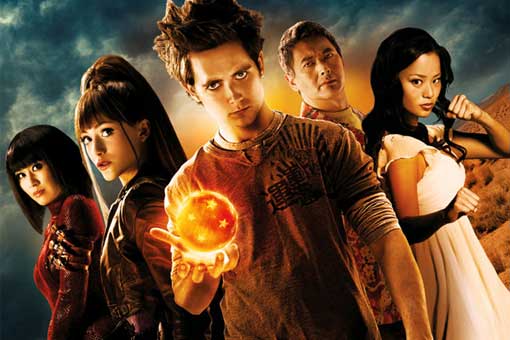
Based very loosely on the original “Dragon Ball” story manga, “Dragonball Evolution” tells the story of Goku (Justin Chatwin), a mild-mannered high school student and martial artist living with his grandfather, Gohan (Randall Duk Kim). He’s relentlessly bullied by all but his crush, Chi-Chi (Jamie Chung) and the only silver lining he has to look forward to (his eighteenth birthday) is cut short when an ancient demon overlord named Piccolo (James Marsters) kills his grandfather for the artifact that was to be given to Goku as a present: one of the seven magic Dragon Balls. These starry glass orbs, sought out by many but found by few, are rumored to have the power to summon a powerful dragon capable of granting wishes, and Goku is instructed by his dying grandfather to seek out the legendary martial arts master Muten Roshi (Chow Yun Fat), who possesses both another Dragon Ball and the skills needed to help Goku continue his training. Joining him too is Chi-Chi, a young engineer named Bulma (Emmy Rossum) and an opportunistic thief named Yamcha (Joon Park), all of them banding together to seek out the Dragon Balls before Lord Piccolo has another chance at ultimate power.
As bad as I suspected this was going to be, I’m at least glad to see some great acting among the otherwise bored, wooden, and unfocused cast. Hong Kong legend Chow Yun Fat as Roshi, for instance, was a great casting choice in spite of the age gap, and he gives a remarkable performance considering the awful script gives him nothing to work with. James Marsters is similarly wasted as Piccolo, as the actor can and has done villains much better than what the movie is letting him portray. Those sorts of limitations, I feel, are reflective of the entire movie itself: a half-hearted effort. For a start, the production was clearly done as cheaply as possible. Every costume (especially Goku’s iconic martial arts uniform) looks like a discount Halloween costume, the sets consist of fake looking blue-screens of desert landscapes, and even the special effects during fight and magic scenes are laughably executed to cut corners. This rings especially true for the ki attacks, all of which look like computer screen-savers. Barring the two that I mentioned, the casting is also completely off, and it’s unambiguously worse here than in “Ghost in the Shell”, since Scarlett Johansson was at least able to deliver a fairly gripping performance. Justin Chatwin as Goku, meanwhile, was entirely miscast, and not just because of the obvious case of whitewashing. I won’t place 100% of the blame on him, especially seeing how meandering the direction is here, but Chatwin delivers the same kind of heroic monologues the original Goku would spout with all the passion of an automated phone caller, and his attempts at wrenching emotions out of theoretically dramatic scenes are rendered laughable as a result of his apparent inability to appear invested in the story. What baffles me most about this, however, is trying to figure out what kind of thought process led someone to make a more “grounded” version of Akira Toriyama’s passion project. Even at its worse, the original manga and many, many series that succeeded this movie’s source material were written with passion and character, both literal and metaphorical. This film could have at least done well to capture the cheesy, action-packed fun of the shows that came after the old “Dragon Ball” manga, but instead, this feels like a cheap mockbuster mean to make as much money as could be gleamed from such a low-effort disaster. Whereas “Ghost in the Shell” at least attempted to save the original themes of the animated film from being lost in Americanization, this film seems more like an internet fan film without the kind of passion and creators’ attachment that would otherwise forgive this sort of amateurishness.
I’d normally go on, but in truth, I don’t enjoy playing the part of the “angry critic”, and really, the only purpose that “Dragonball Evolution” serves is to highlight what purist fans are talking about when they say they dread American adaptations of anime. This is easily the worst of those by miles, and deserved every bit of mockery it’s already received. Avoid, avoid, avoid.
 Rich Reviews