
A couple of years ago, I reviewed the American Netflix film adaptation of “Death Note”, and through that, I had hoped to explore a rather contentious topic among both fans and critics: live-action American films based on anime. Still, try as I might have to balance the few positives against the many negatives of that particular film, I don’t believe that covering just one of these adaptations will do the overall discussion justice. The release of the Robert Rodriguez/James Cameron film “Alita: Battle Angel” has seen to yet another chapter being written in the saga of the “live-action anime” discussion, and to this end, I’m dedicating the month of March to a review feature on several of these films: Ani-March. There is a surprisingly high volume of American film adaptations of fairly popular anime, and each of them have fallen under a fair amount of scrutiny. That in mind, I’ll be starting the month’s feature with the Wachowskis’ “Speed Racer”, since it offers a fascinating (if not always watchable) exploration of just how much the original spirit of an anime can be translated between mediums. The answer to that question here is “most of it”, and while the results certainly didn’t make for a remarkable movie, it’s certainly not one I’d like to throw to the fire with the rest of this month’s lineup.
In a futuristic world where dangerous, high-speed car racing is the sport of stars, young newcomer Speed Racer (Emile Hirsch), is one of the most promising racers in the professional circuit, as his skill is dwarfed only by his lifelong passion for racing. He’s got a lot of support in his career, too: his parents, Mom (Susan Sarandon) and Pops (John Goodman), run an independent auto repair shop and serve as constant moral support and mechanics, and he can always count on his girlfriend and spotter Trixie (Christina Ricci) and his precocious younger brother Spritle (Paulie Litt) to cheer him on. Things take a turn for the insidious, however, when Speed is offered a lucrative, yet shady contract from racing promoter E.P. Arnold Royalton (Roger Allam), who makes it clear that racers that refuse him will suffer his wrath and sabotage. The young racer sticks to his guns, however, remembering the dirty dealings of his racer brother Rex that haunted him until his death in a car accident. With only his passion, family and the racing capabilities of the powerful Mach 5 to combat Royalton and his associates, Speed strives to make it all the way to the top of the Grand Prix, all while another pro racer, the mysterious masked detective known as Racer X (Matthew Fox) investigates a string of violence and sabotage going on off the tracks.
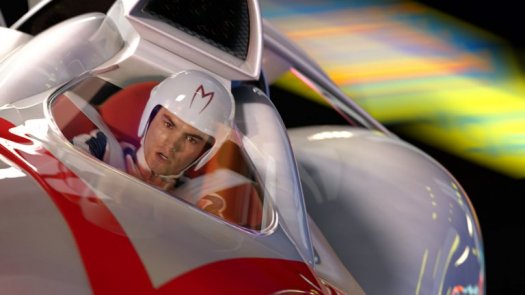
Many of the worst American adaptations of anime in live-action film (a lot of which will be part of this feature) suffer from a common problems: a lack of demonstration of the source material’s spirit and the watering down of concepts for mass appeal. While “Speed Racer” has many problems, I’m at least happy to say that a lack of respect for the original is not one of them. In fact, the movie’s love for the campy racing anime of the same name is one of its greatest strengths, and it manifests in some truly remarkable ways at times. The performances of the cast, for instance, reflect a sense of fun self awareness of the kind of lighthearted action-comedy that the original series tended to be, and there’s “soap opera” earnestness to even the more low-key performances (such as those of Emile Hirsch and Christina Ricci). In particular, I think that the highlights of the film’s performances include Matthew Fox, who turns in a comically serious, Batman-esque portrayal of Racer X, and John Goodman, who actually manages some genuinely parental and heartwarming moments in between hamming it up as Pops Racer. Unmistakably the best performance, however, is Roger Allam as Royalton, a villain who would have fit right in with the original cast in spite of being a creation for the movie, and whose smug, passionate monologues might have been typical corporate gibberish without the gusto of Allam’s delivery. Even small details, such as those on the designs of the cars and an affectionate cameo appearance from original Sped Racer voice actor Peter Fernandez, make for an enjoyable watch, especially for one who grew up watching the show like I did. On the technical end, the art direction also does well to capture the essence of the anime’s iconic races, and even though this movie is set in a more conventionally futuristic world, the set and effects always make sure to prioritize color and vibrancy, especially in the racing scenes. During races, the cinematography will sometimes make use of zooming reaction shots of Speed’s face, which works wonders as both a nod to the show and a tension-building tool. These scenes naturally rely heavily on CGI, but in spite being wonky at times, the action scenes on the race tracks and their transitions between conversational scenes is remarkably original and even artistic in some places.
The key phrase, unfortunately, is some places, and as with most of the Wachowskis’ filmography, their earnestness has bred many things to criticize about “Speed Racer”. While the art direction does make for some remarkable cinematography and effects tricks in theory, it often leaves much to be desired in practice. While being fast paced is something to expect of this movie, some of the transitions are simply far too jarring, especially during the races, during which shots seldom last a few shots before cutting. Also, while the reliance on digitally-rendered, colorful sets does help to establish a fairly and original and consistent tone, it also makes the overall visual element rather tough on the eyes. Save for one towards the end of the film, the racing scenes are extremely difficult to follow as a result of the jump cuts and visuals, and this kind of erratic pace sadly bleeds into the narrative as well. Emotional or tense scenes involving Allam or Goodman often end in an abrupt cut to a visually overtaxing race or an unfunny scene focused on the rambunctious Spritle, and the default transition between scenes seems to be a wide-angle shot of a character speaking followed by a curtain wipe. Not helping matters is the B-plots involving Racer X’s investigation of Royalton and Speed’s questioning of his identity, both of which go nowhere seeing as how little they have to do with the story of Speed’s racing career. While I appreciate the film’s attempt to have a style all on its own, I can also say with certainty that the movie often goes too far in that endeavor. Still, there’s a reason I started with this movie, and it’s because “Speed Racer”, while objectively a failure in a narrative sense, at least fails in ways more remarkable (or at least, more tolerable) than some of the other films listed in this feature.
All in all, the Wachowskis’ “Speed Racer” film is as earnest as it is dumb, and as visually unique as it is exhausting to watch. Fans of the anime would do well to see this, but there’s ultimately too much holding it back from being better than “okay”. Ani-March continues tomorrow with yet another portrait of controversy, mixed reception, and haphazard production. One could call the next subject a “Major” mess…
 Rich Reviews