
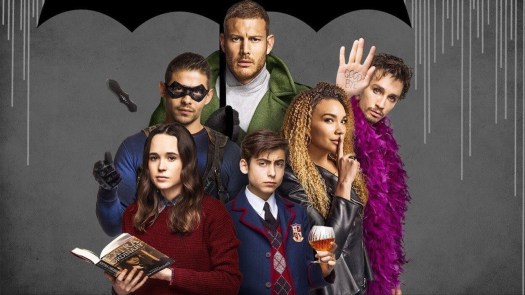
If you’ll excuse the lack of a truly ramping introduction, I must start this review by stating the readily apparent: “The Umbrella Academy” is weird. I’m much less familiar with the Gerard Way comic book that inspired it, but from what I can tell, both the new Netflix series and its source material fall under a category of superhero stories that I can only describe as “dark deconstructions”, with the original comic book being best described as “‘Watchmen’ meets ‘The League of Extraordinary Gentlemen'”. Still, for all the Gothic, Tim Burton-esque art filling the pages, there always seemed to be a somewhat satirical angle to the portrayal of the superhero elements, and the first Netflix season seems to be turning the black comedy up a notch, and the dark fantasy elements down about half a notch. That’s not to say there’s no thrills to be had here (in fact, “The Umbrella Academy” is a bleak, harrowing series in many places), but the balance of serious drama and knowing winks to the larger superhero canon is a tough one to even out. Still, in spite of some expected tonal issues, and a few others in the way the story is told, I still think that “The Umbrella Academy’s” first season is unique, compelling, and thrilling enough to be worth an enthusiastic watch. In fact, my prior description of the intriguing premise is something I’d like to apologize for, since I feel it doesn’t quite do it justice. So, what is the story?
“The Umbrella Academy” is set decades after a strange event in 1989, in which 43 separate women from around the world gave birth spontaneously. Seven of these children, adopted by eccentric billionaire Reginald Hargreeves (Colm Feore), were born with supernatural powers, and trained by their adoptive father to use them to heroic ends as students of the “Umbrella Academy”. All but one of them grew up and forged their own paths as adults, and in spite of being estranged from their cold, distant father, are brought together by his death. Among those attending the funeral are Luther (Tom Hopper), the team’s de facto leader blessed with superhuman strength, Diego (David Castañeda), the rebellious vigilante with uncanny precision in knife-throwing, Allison (Emmy Raver-Lampman), an actress with the ability to control minds by spreading rumors, Klaus (Robert Sheehan), a mischievous drug addict who can speak with ghosts, and Vanya (Ellen Page), a timid violinist held as the black sheep of the family for her lack of powers. The family is naturally conflicted on whether or not to investigate, given their dysfunction, but are kept together once again upon the sudden emergence of another sibling, known by his callsign Number Five (Adian Gallagher), whose time-hopping abilities have led him to discovering the onset of an apocalyptic event that he believes the family may be able to prevent. This preventative push, of course, is no easy feat, since the Hargreeve siblings must also juggle the dangers of mysterious assassins, long-held family secrets, and the wide-reaching tension that has followed each sibling since their split years ago.
If you think that premise synopsis was a little on the lengthy side, it’s only because there really is that much going on, and it’s because of this that I’ve got so much to say about “The Umbrella Academy” on both sides of the critical spectrum. As usual, though, I do want to talk about the strengths of the first season, because there are tons of them that make the show worth binge-watching (as I did). For one thing, it’s biggest strength is most definitely the characters and acting. The characters themselves can be somewhat annoying at times, but are intentionally so due to the core theme being family dysfunction, and in spite of there being a large main cast, each character gets equal time dedicated to them, and equally stellar performances. An obvious example of this is Ellen Page as Vanya, who gives the character a tangible level of angst and resentment without overplaying those aspects of her characterization, but the family as a whole is remarkably spot-on. It’d lengthen the review considerably to describe what all of the cast does right, but some highlights for me were Adian Gallagher as the de-aged Number Five for being able to convey his wisdom and snide cynicism in spite of his young age, and Robert Sheehan’s performance as Klaus, who could have been annoying had the actor not balanced Klaus’s more serious introspection with some hilarious, well timed instances of comic relief. The cast, as a result, has a lot of great chemistry, and the story surrounding them is a gripping thriller that always had me genuinely interested in what happened next. Additionally, the cinematography really makes the show stand out among other works of its genre, thanks to some clever, quick transitions between time periods (childhood and adulthood, in particular) and use of perspective during character-centric scenes. A fun little visual element of note is how the intro of each episode like to play with the title card, which often appears on hidden umbrellas or other such background objects that go unnoticed until the title pops up. These filming tricks are all in service of a fairly macabre tone already set by the supernatural and time-bending elements of the show’s story… for the most part, and this is where the first of the season’s problems emerges: in its tone.
While my knowledge of “The Umbrella Academy” comics is cursory as best, I did manage to get some perspective from a friend and longtime fan on the source material, who, in spite of enjoying much of the show, noted that some of the comic’s weirder elements are dropped out, with what’s left being mixed in with a tone set for more general audiences. That certainly shows, even for one less familiar with the comics, since the often heavy and disturbing drama clashes with more light-hearted scenes with a satirical bend reminiscent of the “Suicide Squad” movie (though thankfully, on a much less intrusive level than that film). Also, while I’ll still say that the story knows how to grab and hold onto an audience’s investment, I think part of the frustration of that investment is that the pacing drags considerably across the episodes. The problem with having the cast being an extended, dysfunctional family is that the separate characters breed separate sub-plots, each one of which take what feels like hours to converge when they should. While I’m glad that each Hargreeves sibling is on equal footing, it also means that the central conflict takes something of a back seat to the plots wrought by the far-reaching cast. In that sense, I’d say that “The Umbrella Academy’s” first season is another show that suffers from being over-ambitious. The tonal and pacing issues reaffirmed by my friend aren’t something I’d chalk up to lack of care or executive mandate (like the aforementioned “Suicide Squad”), but they’re still a problem the show has, admirable though their roots causes may be.
Still, I’d give the debut of the Netflix “Umbrella Academy” show a fairly enthusiastic recommendation. It’s fun, thrilling, populated by likable characters, and actually has some meaningful, worthwhile things to say about family dynamics and the nature of the superhero genre and the psyches of its archetypal characters.
 Rich Reviews