
The annual Academy Awards have certainly had their ups and downs when it comes to their nominations over their long and considerable history. If there’s two things that can be guaranteed to get some attention, for example, it’s films inspired by true stories, and movies specifically inspired by true stories that evoke the history of the entertainment world’s evolving effects on race relations. My summation should not be taken as a disclaimer, mind you. In fact, I’m glad more attention is given to films that have something positive to say about mending the racial divide in America. Still, there are right ways to address the issue (such as in “Do the Right Thing”), and wrong ways (such as in the somehow Award-winning “Crash”), and sometimes a nomination does not equate to overall quality so much as it indicates the subject matter. Still, the latter classification does not apply to today’s subject, “Green Book”, as I’d argue it’s a movie that earns all of its nominations it received this year thanks to its stellar performances, on-point cinematography and strong sense of heart. The result may not always be seamless, but it definitely makes “Green Book” worth watching and discussing. It’s only a shame I’m as late as I am on such a discussion.
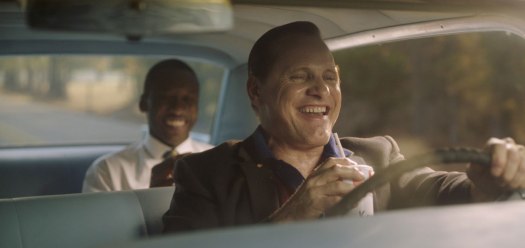
The film, inspired by the journey of real-life figures in the music and entertainment worlds (and named after a road guide for people of color to find welcoming lodging and diners in the 1960s), tells the story of Tony Vallelonga (Viggo Mortenson), a down on his luck, Italian-American nightclub bouncer who gets a promising job offer from a seclusive client. His employer: African-American classical pianist Don Shirley (Mahershala Ali). The job: drive him across a long concert tour of the Deep South as his chauffeur and bodyguard. The trip is about as harrowing as one could expect for a trip of this nature, but the obstacles don’t begin and end with the racist atmosphere permeating the South in 1962. Tony, for one thing, has a temperamental, somewhat bigoted chip on his shoulder, while Dr. Shirley is juggling with countless insecurities of his own. Through the nearly-month long trek across the country comes a story of music, prejudiced institutions, and friendship as the two men gleam new insights about America and each other along the way.
The story being told here is a tale as old as time: unlikely associates turned friends become better people through shared experiences. Still, familiarity need not necessarily breed contempt, and stories like this are often made all the better by chemistry and performances, both of which the movie has in spades. Though I couldn’t tell you just how historically accurate “Green Book” is (I’m told there are quite a few liberties taken here), I can definitely say that the two leads are endlessly compelling. Viggo Mortenson, for one thing, gives an absolutely spot-on performance as Tony. Cocky, temperamental, and casually bigoted mobster-type characters are fairly well-trodden territory, but Mortenson gives Vallelonga some much appreciated charm and humor that makes his emotional arc throughout the film all the more believable. Tony’s still a no-nonsense thug with a hot temper, but he has a softer side that Mortenson effortlessly endears with. On the more nuanced end of the spectrum is Mahershala Ali’s equally perfect turn as Don Shirley. What’s especially difficult about playing a polished, reserved character like Shirley is moderating just how emotion he displays from scene to scene, which makes Ali’s mastery of Shirley’s polite, slightly haughty demeanor all the more impressive as we see firsthand the kind of racist hurdles the refined pianist had to jump over. What’s more, the characters’ performances contrast so well that the chemistry between the two is all the more remarkable. As the movie goes on, these two cease being performances in every scene, and starts being a perfect friendship calcified into the medium of film.
There’s more than just the two leads to enjoy about this film, though. The cinematography and period-relevant direction, for instance, are both quite on point. Lighting and camera tricks convincingly capture the atmosphere of the early 60’s, and what really stood out to me was the use of driving and music in the transitions between scenes. Piano music will start to play between the end of a conversation and the beginning of one of Shirley’s concerts, and passing cars punctuate a wiping transition to a new scene’s establishing shot. It’s little touches like this that add some understated, yet much appreciated cinematic flavor to what could be classified as a fairly conventional Hollywood drama. Even then, I feel like that “conventional Hollywood drama” classification is selling “Green Book” incredibly short, for while it does take predictable turns as per most films of this category, that should not at all take away from the film’s execution and undeniable earnestness. A bad film for me is one that doesn’t care about its subject matter, and that’s not something “Green Book” can be accused of doing. In the film’s cinematography, performances, and depiction of nation-wide racial discrimination, we see firsthand the kind of struggles both men had to face on the trip. Unlike patronizing films like “Crash”, however, “Green Book” attaches human struggles and emotion to the central themes of bigotry and overcoming surface prejudices. Tony is far from the most forward-thinking man in America, but he’s not as thick-skinned as one might initially think, and his openness with his own emotions helps to guide Shirley as much as Shirley guides him in being more polite and worldly. Shirley, by point of comparison, does more than simply act as a mentor to Tony, and has just as much to learn about communal intimacy as Tony does about race relations. The best movies taking aim at America’s past ills, in my opinion, are the ones that do so through human experiences rather than through vessels for a soul-less after-school special message.
“Green Book”, in other words, more than qualifies for being one such film. It’s charming, perfectly acted, and tugs effectively and expertly at the heartstrings.
 Rich Reviews