
That films like Spider-Man: Into the Spider-Verse don’t happen more often is a sad state of affairs, especially given the long and storied history of both the Spider-Man character and other superheroes under the pop culture radar. Still, if any hero were to get the loving, multiverse-wide film treatment, the first probably would have been Spider-Man. After all, as we’ve covered over the last few reviews, the character and the costume have seen many a different interpretation for decades on end between comic books, film, video games, and other such commercial and artistic media. Into the Spider-Verse had no small task in its narrative: Encapsulate everything that made the hero that made him (or her, in many stories) so enduring and popular, and make that sort of ethos the core of the film’s thematic ambitions. This film is not only remarkable for succeeding on those fronts, but for reminding its audience that potential for films (and not just films about Spider-Man) have limitless potential if people are willing to do something new and passionate. There’s a lot to talk about, so pardon the lack of an extensive, ramping intro. Oh, and the potential for light, albeit marketed spoilers.
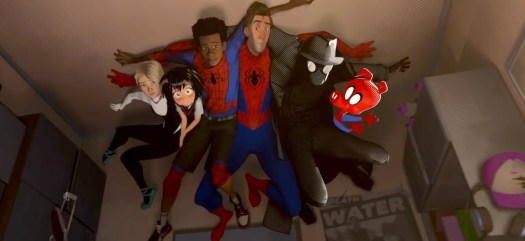
Miles Morales (Shameik Moore) is an impending boarding school student whose high school-bred anxieties could be considered the biggest concern in his life had he not lived in a New York populated by crime of both the typical and super-powered varieties. That’s not to say school is any easier for him, though: his police officer father, Jefferson Davis (Brian Tyree Henry) has colossal expectations for him, which only heightens Miles’ fear of failure, and after a walk through the city, Miles’ fear for his own safety becomes just as omnipresent after gaining powers from a familiar spider bite and being tasked with stopping an experimental dimensional portal by a dying Spider-Man, soon revealed to be college graduate Peter Parker. Though all of New York’s in mourning, Miles has little time to ruminate, as the portal Spider-Man discovered leads the primary universe Peter Parker (Jake Joshnson) right to Miles. He’s asked by Miles to show him the ropes (or webs, as it were), but Peter refuses at first, having suffered his own heartbreak involving a divorce in his own world and being determined to return home. Still, Miles’ determination soon sways Peter into becoming his mentor, and it’s not long before the collision of universes leads them to Spider-Gwen (Hailee Steinfeld), an alternate, spider-powered incarnation of Gwen Stacy on her own mission to stop the villains behind the creation of the portal. Joining them still are spider-based heroes from other universes, including future born, Japanese-American mech pilot Peni Parker (Kimiko Glenn), a hard-boiled, trench coat clad Spider-Man from a black and white world set in the 1930s (Nicolas Cage), and a cartoon pig with spider powers, dubbed “Spider-Ham” (John Mulaney). Simultaneously amazed and terrified at the prospect of being his world’s hero, Miles is faced with a choice with all of the odds against him: rise to the daunting standards set by the “Spider-Men (and women)” of the worlds endangered by the portal… or refuse the call, and doom those heroes to disintegration and his city to crime.
As I implied in the intro to this review, Into the Spider-Verse is a fantastic movie, taken both as a love letter to the character and as a standalone film making use of the medium of animation. I’ll naturally be discussing the second category first, since the movie’s distinction as a mainstream animated film means that the Hollywood higher-ups might actually give the medium some long-overdue credit for what kind of stories can be told with it. To start, first impressions of the movie’s toying with frame-rate and choppy motion might have been mixed at first, but its execution as a whole has surpassed all expectations, as the animation as a whole is colorful, vibrant, and still dripping with energy, especially in the action scenes, and those frame-rate tricks mean the more restrained scenes of dialogue flow unnaturally smoothly into the fights and web-swinging set-pieces. What’s also remarkable about the visual elements is the use of comic book effects and formats: dialogue boxes will pop up when a character’s thoughts are being spoken, sound effect captions will subtly pop up in the middle of an action, and the transitions are framed like moving along comic panels. What’s going on here is a bold act of defiance against conventional Hollywood animated movies: a sacrifice of realism in exchange for bold and dynamic style. Against any odds, this style of animation has few, if any, hiccups, and the result is the perfect cinematic equivalent of an “animated comic book”. What’s more, the story being told through these visuals is unambiguously intended for broader audiences. That’s not to say that kids couldn’t enjoy it (after all, it is a “Spider-Man” movie), but the increase in darker storytelling elements and how they’re balanced against the typical beats hit by other children’s animated movies means that there’s universal enjoyment to be had with it.
Visuals and direction are far from the only things going for this movie, though. The narrative elements here really do serve as a veritable love letter to Spider-Man, and not just as a superhero character. Everything encompassing the history of the Spider-Man name is encompassed here through the use of the multiverse framing: Spider-Man as a hero, as a pop culture icon, and as an object of commercial tie-ins is put up into one giant display, and the story wears its love for all of this on its sleeves. The film’s thematic ambitions are far from subtle, but it’s an understated one about Spider-Man as a hero: anyone (be they men, women, children, or… pigs) with the means and the heroic spirit has the potential to be at least a little bit like Spider-Man. None of this message would have resonated without likeable characters, but Into the Spider-Verse has no shortage of that, as each of them are wonderfully written, well-voiced, and endlessly endearing in their own ways. Jake Johnson’s take on Peter Parker is a primarily de-constructive one, as he puts the immaturity and sarcasm of the character on full display, but it’s hard to outright hate the character thanks to the charm he exudes and the focus the story puts on his growth alongside Miles’s own arc. Speaking of which, Miles’s growth as his world’s Spider-Man and as an adolescent protagonist lends itself a a cavalcade of hilarious, heartwarming, and heart-wrenching moments, and this is due in no small part to Shameik Moore’s natural youthfulness and painfully authentic vulnerability. Hailee Steinfeld also continues to be a master of nuance even in animated form as Gwen Stacy, as her initially rough, detached demeanor is deceptively difficult to sell like she does in this movie. Special mention must also be made of Kimiko Glenn’s cheerful, charming voice work as Peni, along with the hilarity of Nicolas Cage’s channeling of Humphrey Bogart as the Noir universe Spider-Man and John Mulaney’s channeling of Mel Blanc as Spider-Ham. The only criticism I could muster for any of these characters is that I wanted more of them, but even that seems like a complaint that will soon be short-lived with how well the movie is doing.
There’s so much to praise and gush about in Into the Spider-Verse that I feel bad even approaching it with my typical review format, but I’ll conclude that the film is a beautifully animated, hilarious, and emotionally overcharged send-up of Marvel’s flagship superhero, and thanks to the universal nature of the lessons it breeds, it’s one that everyone, Spider-Man fan or not, should treat themselves to. I hope my dancing around spoilers has encouraged you to do so. See this as soon as you can.
 Rich Reviews