
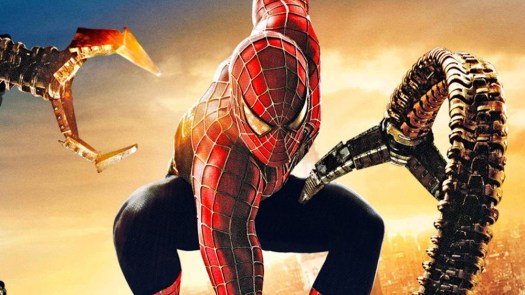
The previous review for “Spider-Month” saw me revisiting the first movie in Sam Raimi’s series of “Spider-Man” movies, and I was happy to see that there was more than my own personal attachment to enjoy about it. Even after being rendered somewhat dated, I still believe that the first “Spider-Man” movie was an entertaining, emotionally charged movie with a lot of great action scenes spot-on performances, and a lot of love for its source material. It was also a record-breaking hit at the box office, rendering a sequel almost inevitable. Spider-Man 2, released just two years after the first film, is considered by many fans to be the best “Spider-Man” film ever made, citing the root of its acclaim as the increased focus on the tragedy and inherent dramatic tension that Spider-Man as a character is cursed with. Indeed, this film’s focus has shifted away from the wonder and joy of Peter Parker’s super-heroism, opting instead to focus on the stress of that heroism following the loss of numerous loved ones and the expected stress of everyday life outside his dangerous superhero career. Remember, a major theme of Spider-Man’s conception is that power breeds responsibility, so it’s only natural that a continuation of his story would be about the trials interwoven between both of his identities. All of that said, Spider-Man 2 is far from free of the melodrama that was present in the first movie, and the tonal shift does come with its own set of flaws, but the film still manages to hit the same beats as the first film while doing much, if not all, of what it sets out to do.
Set a few years after the defeat of the Green Goblin in the first movie, Spider Man 2 shows that continued heroics have taken their toll on the now college-bound Peter Parker (Tobey Macguire), whose relationships with Mary Jane Watson (Kirsten Dunst) and Harry Osborn (James Franco) have been greatly strained. To make matters worse, his Aunt May (Rosemary Harris) is in danger of eviction, and stress outside of his heroics have had restrictive effects on Spider-Man’s powers. His choice to hang up the suit, however, may have been made too soon, since a new villain has emerged in the form of Dr. Otto Octavius (Alfred Molina), a scientist and former mentor to Parker who lost his wife to a failed fusion generator test and his sanity to his malfunctioning robotic arms. No doubt headed for the toughest phase of his career as a superhero, the man who would be Spider-Man must choose between his attachments and his newfound responsibilities as the recently-dubbed “Dr. Octopus” threatens to swallow whole everything he hold dear.
As one could tell from the plot synopsis above, the stakes of this film have been significantly raised since the last installment, as have the thematic ambitions. In my review of the Insomniac “Spider-Man” game, I talked about how some of the best Spider-Man stories are the ones that explore the difficulties of balancing Parker’s double life and responsibilities between both identities. So, what do I think about its execution here? Well, my thoughts are somewhat mixed. Spider-Man 2 works quite well as a continuation of the first film’s narrative, and the story itself is well-paced and well acted enough that nothing seems unnatural or contrived (unlike another installment we’ll soon be discussing). Still, what worked so well about the melodramatic and theatrical style of the first Raimi film was that it was kept in perfect moderation with the more lighthearted elements of the Spider-Man mythos. Here, the adventurous and fun elements are turned down a notch, and the dramatic ones are brought up about two notches. In many ways, this works perfectly, and much of that is due to the performances once again. Naturally, Tobey Macguire and Kirsten Dunst continue to completely nail their characters along with the rest of the cast, but something I see as an unambiguous high point of the second movie is Alfred Molina as Octavius. Molina went on record as saying he enthusiastically prepared for the role and was ecstatic to be cast in it, and it shows, since he perfectly balances sympathy and cold villainy in spite of the transitions between those two sides being somewhat rushed. The tragedy of Otto’s situation could easily have come across as heavy-handed, but Molina being the master of nuance that he is made it feel genuine in spite of the destruction his character sows.
On the other hand, there are moments that push the limits of cheesiness, and the risk the movie often runs at being heavy-handed becomes a reality whenever the topic of Peter and Mary Jane’s romance pops back up. That’s not to say you don’t come to care for them, but Mary Jane is not particularly well-written this time around, and the extent of her perspective we get in this film is that she resents Peter’s aloofness. The on/off again tension, while effective in the film’s final moments, becomes rather tedious at times, and that’s especially true of an engagement subplot that ends up going nowhere and only serves to remind us that Mary-Jane is hurting on the inside. If I had to describe the bad side of Spider-Man 2 in one word, it would definitely be “overambitious”. It’s clear that the cast and crew continued in their investment with this story, and that they made an admirable attempt to expand on the themes established by the first film. “Admirable” truly is an apt description, and Spider-Man 2 will still get an enthusiastic recommendation from me, but I urge any readers to take that recommendation with a grain of salt. It’s an excellent sequel, to be sure, but being a sequel, you’ll probably only enjoy it as much as I and others did after watching the first movie. Between the two, you’ll get plenty of great action set pieces, charming performances, and heartfelt comic book storytelling, but their strength as a whole kind of detracts from Spider-Man 2‘s individual strengths.
 Rich Reviews