
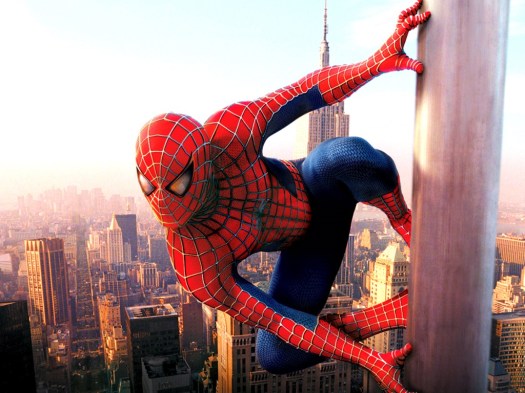
After the difficult and long-delayed review of Bird Box (for which I’d like to vehemently apologize), the best thing I thought of as a way to recover from that messy review process was to review every major theatrical take on arguably the most popular Marvel superhero of all time, in preparation for a review of a certain related cinematic outing. Ladies and gentlemen, welcome to Spider-Month.
I’ve always had something of an attachment to the web-slinging, wisecracking Spider-Man, and seeing as how I’ve reviewed both Spider-Man: Homecoming and the recent PS4 video game on this blog, I thought it only natural to treat myself to a review of every other “Spider-Man” movie to come out prior to the latest one, Into the Spider-verse. Naturally, however, the aforementioned “Spider-Man” outings will not be discussed this month in the interest of avoiding repetition. That said, I’m happy to begin with the first installment of a trilogy of “Spider-Man” films by acclaimed director Sam Raimi. This first “Spider-Man” film, often considered a standard-setter for modern superhero films, is also criticized for cheesiness in equal measure. Still, while the first of Peter Parker’s many cinematic efforts is quite dated in some regards, I’d nonetheless confident in saying that Spider-Man is still important, entertaining, and heartwarming enough to be dubbed a modern classic of superhero cinema.
The story of Raimi’s first “Spider-Man” movie is lifted almost wholly from the comic story that started it all: Peter Parker (Tobey Macguire) is a hapless, nerdy, and unimposing teenager whose life outside of academics is low on luck and high in stress. He’s awkward around the girl of his dreams, Mary Jane Watson (Kirsten Dunst), and is a popular target of bullying, and the only consolations he has are his friendship with Harry Osborn (James Franco) and the loving support of his Aunt May and Uncle Ben Parker (Cliff Robertson and Rosemary Harris). His life takes a major turn for the exciting, however, when a mishap at a local science exhibition ends in him being bitten by a genetically modified spider, the exposure to which grants him superhuman strength, a precognitive “Spider-Sense”, and the ability to stick to walls and shoot organic webs. Feeling great about life, Peter uses his newfound strength to make a profit out of professional wrestling, only to be rewarded for his youthful carelessness when an armed robber he neglects shoots and kills his Uncle Ben shortly after. This experience ingrains in him an unmistakable lesson: “with great power comes great responsibility”. Using that as his creed, the formerly meek Parker takes up a new identity (and new costume) as the friendly neighborhood Spider-Man, and receives his first true test as a superhero when a longtime family friend (Willem Dafoe) emerges as a new villain that threatens the peace in New York.
If any strength of Spider-Man could be called its greatest, it would be its faithfulness and masterful translation of the earliest comic stories. The origin story of Peter Parker is well-trodden, and was even very familiar when the film first came out, but Sam Raimi and the rest of the film-making staff adapted the story with panache and enthusiasm, and the cinematography does well to translate iconic Spider-Man moments to the big screen in ways that really give the film its own identity. That’s not to say the effects utilized to this end are flawless (with the early-2000’s CGI rendering Spider-Man weightless and awkward in certain scenes), but when Raimi’s iconic camera work and art direction are on point, they are very on point, and nowhere is that more apparent than in those iconic swinging scenes. Spot-on tributes to the original comic are also peppered throughout the spot-on casting, and though I previously mocked Tobey Macguire’s occasionally overwrought acting, there’s no denying that he perfectly encapsulated the wallflower tendencies of Peter Parker and does a decent job with Spider-Man’s deadpan wisecracks in spite of some rough reads here and there. The rest of the cast also slips fairly flawlessly into their roles, and special mentions go to Kirsten Dunst as Mary Jane, Rosemary Harris as May Parker, and J.K. Simmons as the gruff Daily Bugle publisher, J. Jonah Jameson. Additionally, while Willem Dafoe does frequently ham it up as Norman Osborn/The Green Goblin, special note must be made of his ability to credibly portray Osborn’s split personality and inner conflicts.
On top of the combined zeal of the cast and crew of this film, Spider-Man’s creative direction is also inspired in many scenes. There’s always a memorable set piece waiting in the wings as the film progresses, from Peter Parker’s first taste of web-swinging and the iconic upside-down kiss scene. Even in the film’s most overwrought moments, it never ceases to be entertaining or becomes too stale. In other words, where Spider-Man lacks in subtlety, it more than compensates through sheer melodramatic style. “Melodramatic” is the operative word here, though, and there are times where superhero cheese does detract a bit from the narrative. Still, it’s that kind of flair that came to define the modern superhero movie, and that alone shouldn’t take away from the importance of Sam Raimi’s first Spider-Man movie. It’s vibrantly made, well-acted, and did much more good than harm for superhero movies to come. More on that in the next review.
 Rich Reviews