
WARNING: The subject of the following review contains references to suicide and the endangerment of child characters. Reader discretion is advised.
ADDITIONALLY: The review itself contains light, non-specific spoilers. Those wanting a quick, spoiler-safe review should only read the intro and concluding statement.
I’m aware that I’ve probably said this for many a subject of review, but Bird Box is possibly the most difficult movie I’ve ever had to talk about. Even seeing it when it first came out on Netflix in early December didn’t grant me sufficient time to properly develop my thoughts on the platform’s latest hit. Based on the post-apocalyptic novel of the same name by Josh Malerman, Bird Box (much like the book that inspired it) was released years after a string of such stories grew in frequency and popularity in literature and film, so as to stand out and not get “caught in the wave”. Smart as this decision was, it’d be reductive logic to say that’s all the movie had going for it. The reason for Bird Box’s popularity isn’t one I find difficult to explain: the premise it presents is unique one in its genre, and its execution in the film is thrilling, suspenseful, and presents worthwhile themes concerning the human condition. Still, for all the intrigue involved in this movie, there’s just as many things that kept me from absolutely loving it, which is why it took me well over two weeks after seeing it to properly give my own unique take on it. I want to make it clear that the reviews and articles calling the movie’s success a “fluke” are being way too snooty towards its audience, but Bird Box is flawed, and there’s a lot to dissect about it. With that, I apologize for the delays of this little review.
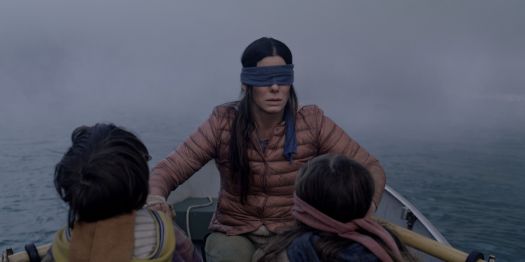
Bird Box starts in media res, following a cataclysmic event of which pregnant amateur painter Malorie Hayes (Sandra Bullock) is a major survivor. Though criticized in the past for shutting herself off from the world around her, Malorie’s withdrawn tendencies end up being challenged when an unseen, indescribable force starts driving people to gruesome, self-inflicted deaths upon seeing it. Though she escapes after a checkup and manages to find shelter with other survivors, she loses her sister in the chaos and finds that the neighborhood survivors are completely at odds with each other, being a diverse bunch under the roof of a vindictive and aggressive old man (John Malkovich) who himself is determined to keep the disaster (and any other survivors) out. To make matters worse, the world outdoors is impossible to navigate unless one is blindfolded to it, and survivors have naught but the frantic chirping of birds to detect the presence of the entity spreading the madness. Surrounded by death, betrayal, and an ever-increasing sense of detachment, Malorie must decide who to trust and how to trust in this blind, mad world.
In the interest of being balanced, I’m going to be talking about the good and bad of Bird Box in equal measure, since the two seem to cancel each other out at every other scene. First off, the first unambiguously good thing going for Bird Box is its cast and acting. The dialogue handed to much of the movie’s cast is quite a mixed bag (as I’ll soon be explaining) but every actor gives it their all and really sells their individual characters, no matter how cliched they can be at times. Sandra Bullock, for instance, was given a difficult character to make 100% palatable or sympathetic, but she slips rather naturally into Malorie’s character as a vulnerable, yet hard-nosed woman in the midst of panicked survivors. It’s a fairly seamless performance, and it was imperative that an actress like Bullock was cast in this kind of leading role. The movie also delivers well on its unique spin on the “disaster/apocalypse” genre, and save for the vaguest of hints towards the second half, the entity/force behind the mass suicides is never directly seen or depicted on screen. To that end, the cinematography and editing work wonders at setting up the kind of tension that already exists with having to be blind to the elements in the story, and what’s truly inspired in this respect is how the film plays with perspective. We never vividly see the world outdoors from outside the view of the main characters, and in spite of the difficulties that must have followed shooting those outdoor scenes, they never do lose steam or become too dull. All in all, it seems like everyone on production really cared about Bird Box in spite of operating with a few cliches, and there’s a lot done here that really makes it stand out.
Unfortunately, the thematic beats and the cliches that follow are still a problem, and the narrative’s execution and strengths can only do so much to compensate for Bird Box’s numerous flaws. For a start, while the movie does have a lot to say about human interaction and societal detachment, it sometimes goes too far in order to weave those themes into the narrative, and this usually manifests through the actions of the characters. Minor characters and even major ones get themselves into danger through embarrassingly avoidable ways at times, and they seem to occur against logic in service of those aforementioned themes. Also, though most of the cast manages to at least be engaging (thanks once again to the excellent acting across the board), the characters themselves tend to fall into well-worn and sometimes outright annoying cliches. Lil Rel Howery’s character in particular is shoehorned into being comic relief, and took away from a lot of the film’s earliest tension. The larger problem, however, lies in Bird Box’s narrative presentation. As stated earlier, the film begins in media res, during the aftermath of Malorie’s initial struggles, and I can’t understand why it was put together this way since such an intro renders much of the film leading up to that so predictable. I’m being quite vague on the contents of that intro for that reason, since knowing what happens in the present day will straight-up ruin the lead-in to that time frame. To borrow and revise a worn-out metaphor, it’s as if the production team on Bird Box took two steps forward, only to trip one step back on all the weaker narrative elements. I’d still say the movie as a whole is still enjoyable, tense, and interesting enough to warrant a watch (especially given the ease of access via Netflix), but Bird Box is just too bound by its own themes and framing to be quite as profound as its popularity would have you believe.
In short, Bird Box is good, but not great, and for maximum enjoyment, it’s best to go in as blind as its main cast.
 Rich Reviews