
When does a failure become a strength?
After my last review of Tommy Wiseasu’s “The Room”, you may be tempted to answer that question by saying that a failure can make a legend through ironic cult status. Much like the memoir of the same name, however, “The Disaster Artist” is not interested in simply recounting the anecdotes of a troubled production. Rather than a simple comedy of errors, the film is also a story of friendship, a behind-the-scenes production story, and a story of the hardships of the acting industry all rolled into one. More than any of those things, however, “The Disaster Artist” is a film whose story sets out to answer the question above, and a compelling story of the simultaneous danger and power of faith in one’s dreams.
Yes. A movie about the making of “The Room” moved me.
Aspiring actor Greg Sestero (Dave Franco) is a painfully nervous aspiring actor living in California, who’s constantly given verbal beatdowns by his instructor for his lack of confidence. His doubts all but evaporate, however, when he meets Tommy Wiseau (James Franco), a gleefully passionate, yet tragically untalented thespian whose lack of stage fright nonetheless inspires Greg and later becomes the catalyst for an unlikely friendship between the two upstarts. The two move in together at Los Angeles, and upon being reminded of the competitive, stagnant nature of the acting industry, decide to further their careers by making a film of their own. What starts out as a promise for a new chance at careers, however, quickly spirals into a gordian knot of production troubles and mutual tension. In addition to “The Room” being a disjointed, wrongheaded mess funded by a troublingly endless supply of money, its problems are all traced back to Tommy’s paranoid, dictatorial, and inept direction. To make matters worse, Greg’s attempts at romance and independent success are met only by bitterness and jealousy from Tommy, who continually refuses to disclose his past even as he pushes Greg and the crews to their limits. Is their hope for Tommy and Greg’s passion project, or will the two be doomed to lose their careers, dreams, and friendships to the turbulent production environment?
Seeing what direction “The Disaster Artist” takes with its depiction of “The Room’s” production is remarkable in its sincerity, and while the resulting product is every bit as funny as you could imagine, it must be stated here and now that the film also has legitimate dramatic weight to it. This is due in no small part to its dedication to paying tribute to Wiseau’s cult phenomenon. Recreations of the film’s most memorable scenes are nearly perfect in their faithfulness, and the actors playing the relevant film’s cast are instantly recognizable. The people behind the scenes also lend themselves to hilarious scenes of outrage towards Wiseau’s lunacy, with Seth Rogen being a particular standout as the script supervisor.
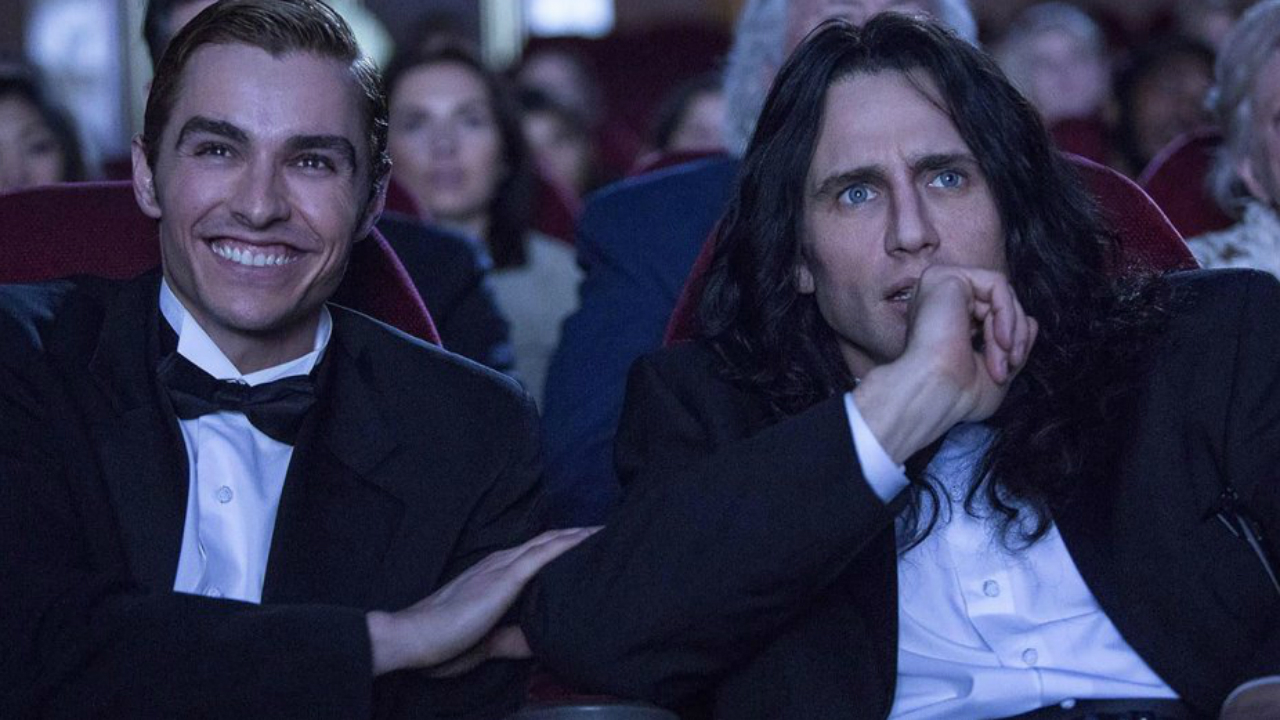
Talking about performances, however, is impossible without affirming the strength of its two leads. Dave Franco, for instance, adds welcome nuance and affable charm to Greg Sestero’s portrayal in this film. Greg’s almost instinctual friendliness and everyman mannerisms are deceptively difficult to portray naturally, but Franco not only succeeds in doing so, but matches the actor’s mannerisms to a tee. Equally impressive, if not more so is the performance of James Franco as Tommy Wiseau. While it may seem readily apparent that he captures the eccentricity and humor of the man from the trailers, the promotional materials don’t do nearly enough justice to his ability to pull off Wiseau’s secrecy and emotional instability. Most people fondly remember the humor of the warped, accidental appeal of “The Room”, but an equally important, yet overlooked fact is that the production was the product of a troubled, inept, and slightly delusional director. In James Franco, we’re given a reminder of the dark side of the widely enjoyed failure, and manages to deliver a spot-on performance that balances charmingly eccentric and defensively prideful without ever having one eclipse the other.
Together, the brothers also emanate such convincing and natural character chemistry that they cease being brothers playing characters and become Greg Sestero and Tommy Wiseau. On their shoulders is a cinematic experience that balances Hollywood cynicism and hope through its portrayal of a friendship forged in industry struggles. “The Disaster Artist” could have easily succeeded by being a Abbot-and-Costello-style deconstruction of Tommy Wiseau’s direction, acting, writing and editing, but the people behind it truly respected Greg Sestero’s observations on the difficulties of working in the film industry. As an aspiring film critic and voice actor myself, I can say that the filmmakers have a deep understanding of this struggle, and of the kind of damage that unchecked dedication to one’s dreams can do. Instead of mocking Wiseau at every opportunity, the film takes time to remind the viewers of his struggles as an auteur, and give equal consideration to Sestero’s tenuous balance between his friendship with Wiseau and his own well-being. Though held back slightly by its inevitably niche status as a tribute to “The Room” “The Disaster Artist” is a funny, charming, and enjoyable exploration of filmmaking, and not since Tim Burton’s “Ed Wood” has there been such an entertaining look at cinematic auteurism.
 Rich Reviews