
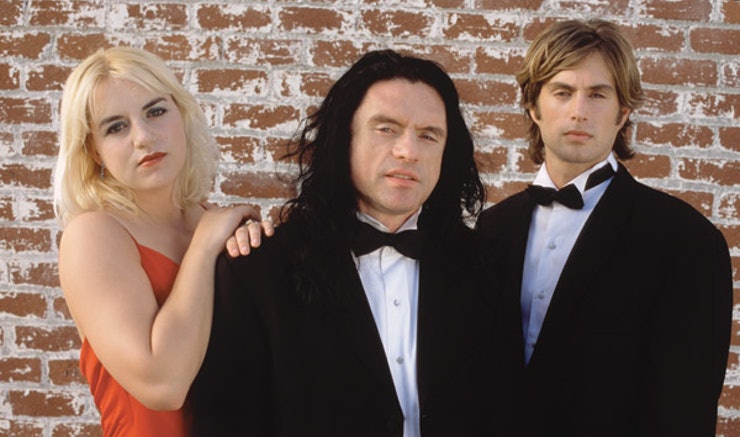
Tommy Wiseau is the type of filmmaker that I’d both readily thank for his work and mock him for it, and no sign is there of the popularity of that sentiment than in the upcoming film based on Greg Sestero’s memoir The Disaster Artist. The memoir on which the upcoming film is based tells a bizarrely genuine story of friendship in the film industry, as well as one of the simultaneous joys and dangers of belief in one’s dreams. The greater story of The Room‘s troubled production, the cult following that resulted from the film’s release, and the secretive life and career of its director and star, Tommy Wiseau, has gone on to attract endless media attention, but this story, along with the impending release of The Disaster Artist, has birthed a recurring question: Is The Room truly that amazing in its ineptitude? In preparation for its December release, I’m here to revisit the original cult classic and find out.
Johnny (Tommy Wiseau) is a successful banker who has it all: a beautiful home in California, a steady income, a caring best friend in Mark (Greg Sestero), and a beautiful girlfriend named Lisa (Juliette Danielle). This high life is turned completely on its head, however, as Lisa begins a clandestine affair with Mark. Tensions rise and Lisa’s scheming becomes more frequent, all while Johnny becomes increasingly paranoid of the truth behind his friends and their interactions with him. Adding to the gripping drama of the days that follow are completely unrelated side-plots involving drug use, breast cancer, and false pregnancies, all of which join together with the performances of the main cast and the central conflict to create a postmodern defiance of standards of quality in film.
In the interest of saving the most obvious criticisms for last, I’ll start out by saying that the plot above is as convoluted and hackneyed as it sounds. Taken on their own, the side-plots are already something you’d find out of a guidebook to drama film plots, but compressed together like they are here, they make for an overarching plot that would have been utterly tedious if it weren’t made hilarious by the acting. Tommy Wiseau’s performance is an unmistakably crucial element of that appeal, since his delivery hits a previously unimaginable middle ground between cartoonishly hammy and flatly wooden, and his physical acting (most notable, his erratic arm movements and repeated glances into the camera) render theoretically dramatic moments a complete joke. Still, credit is due for the performances of the rest of the cast, as their readily apparent frustration and boredom adds the type of glimpse into the troubled production that adds considerable to the already-present hilarity. The cinematography is also amateur, and at times, very bizarre, with city skyline transitions that wouldn’t be out of place on a low-budget sitcom and green-screens that look like low-quality CGI paintings. Typically, I’d be all too willing to write this off as a soulless, talentless independent effort, had it not been for the fact that Tommy Wiseau seems to refuse to be just a bad filmmaker.
If Wiseau’s on-screen gusto and history leading up to the production of The Room are to be believed, he is anything but dispassionate as a filmmaker. As much of a mess as this film was, it’d be impossible to say that the obvious faults were born from careless disregard for the end product. In fact, as someone who’s decently well-read on the film’s production (and Greg Sestero’s recounting thereof), I’d say that passion is the reason why the film is as equally loved and mocked as it is. The Room is still an unambiguously bad movie, but not for the reasons critics typically list, nor for the things that personally irk me about the bad movies I’ve seen. On its own, the film was made memorable enough by Wiseau’s bizarre non-sequiturs (“I did not hit her, I did NOT… Oh hi, Mark!”) and by the incredibly out-of place football-throwing scenes, but knowing what audiences will soon know thanks to the upcoming Disaster Artist film makes it out to be the overzealous type of mess.
Like the man behind it, The Room is a troubled, bizarre, and clumsy picture of bad filmmaking, but it’s those qualities that drew people (me included) to it in the first place. There’s a certain mindset that’s imperative to enjoying this, but if you can ironically enjoy a bad movie, this is a must-see, assuming you haven’t checked it out already. Tommy Wiseau’s ironically-enjoyed masterpiece has to be seen to be believed, and seeing it now makes me even more excited to see the story behind it on the big screen.
 Rich Reviews